
Lesson 2 - Malt Intake, Handling, and Storage
This lesson details the principles and operations of malt intake, handling, and storage. It explains how and why malt is checked on delivery to the brewery. It also covers how it is taken in, processed, and stored, as well as how safety is maintained during malt handling.
Magnets
As we saw earlier, ferrous material is bad news for safety, plant integrity, and product quality. Let’s look at how we remove it.
There are two main types of magnets: fixed and dynamic. Fixed magnets are fitted into easily removable sections of conveyor systems. These must be opened or removed, inspected, and cleaned frequently to prevent them from getting overloaded with metal objects. This is not required with dynamic magnets.
The figure below shows a plate magnet (also called hump magnet) that catches ferrous metal as it flows through a chicane in the ductwork. The ferrous material sticks to a plate next to a magnet. To remove the metal, the magnet is pulled away from the plate.
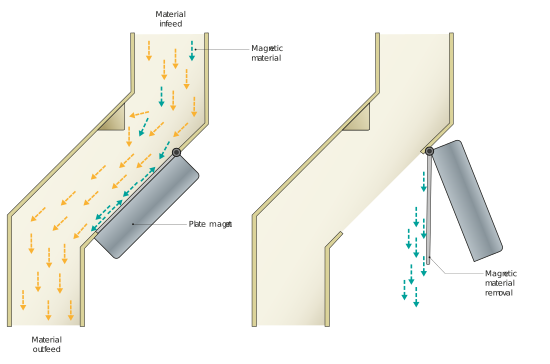
Figure: Plate magnet
Another example of a fixed magnet is the grate magnet, in which magnetic rods are fitted inside metal tubes over which the malt flows. The whole section is removed periodically and the magnetic rods are withdrawn, allowing the ferrous material to drop away. This is shown below.
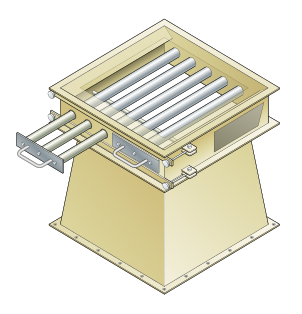
Figure: Grate magnet
Our last magnet design is a dynamic drum magnet where grain flows over a revolving cylinder, half of which is magnetised. The ferrous material sticks to the magnetised part of the cylinder and drops off when it reaches the non-magnetised area and is discharged from the unit.
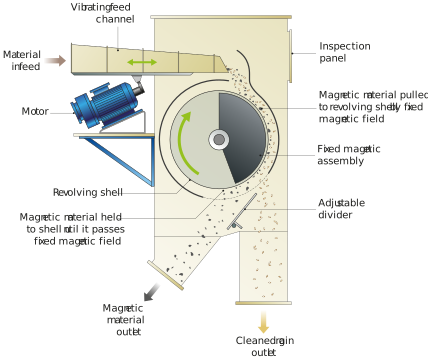
Figure: Drum magnet
We should bear in mind that magnets only attract metals containing iron and so will not remove all metal objects. Other metal objects can be removed in grain cleaning/dressing, destoning, and screening equipment according to any differences between their size/weight and that of the grain. More on this later. Next, we cover storage silos.