
Lesson 2 - Malt Intake, Handling, and Storage
This lesson details the principles and operations of malt intake, handling, and storage. It explains how and why malt is checked on delivery to the brewery. It also covers how it is taken in, processed, and stored, as well as how safety is maintained during malt handling.
Bucket Elevators
Whenever malt is transported vertically, this is likely to take place in a bucket elevator. Let’s find out more.
In bucket elevators, metal or plastic (for improved safety) buckets are fixed to a belt that is lifted and lowered by a motor as it turns. The figure below shows an elevator with some panels removed to illustrate how the grain is carried up and discharged.
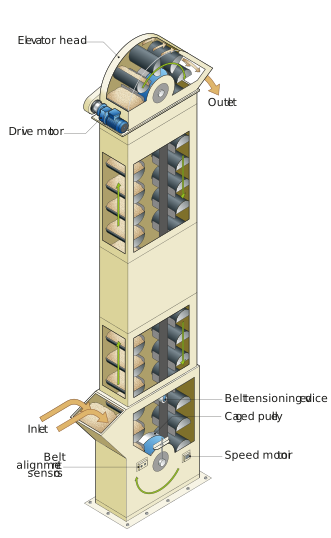
Figure: Bucket elevator
Below is a summary of the key points about bucket elevators.
-
The malt must be metered gently into the base of the elevator to prevent choking (overfilling). Elevators should not be started when full, but instead filled when in motion.
-
Provided the belt is correctly tensioned and does not run too fast, the movement of the buckets is gentle.
-
Since it is fully enclosed, dust aspiration and explosion relief is essential (or a fire suppression system must be used).
-
Grain gathers in the bottom of the housing, which means that some malt from a previous batch can be added to the batch being elevated. It is important that the bottom of the elevator is manually cleaned on a regular basis to remove old grains and dust.
-
Some elevators can be 100 m high and move grain at speeds of up to 2.8 m/s. Elevators are available that can transport up to 90 t/hr of malt.
-
Regular maintenance of belt tension and bucket condition is required (a knocking sound is a good indicator of loose buckets/slack belt).
-
A rotation/speed sensor should be fitted to the bottom pulley to detect any belt slippage as this can cause heat, potentially leading to fire and explosion. Belt alignment detection is also necessary to guarantee safe operation.