
Lesson 4 - Materials Application in Brewing
In this lesson we will discuss materials and their application in greater detail. This will include understanding their properties, advantages and disadvantages, and their main applications in the brewery. We will place emphasis on the materials most common in the brewing industry.
Insulation Materials
Insulation materials are widely used to prevent the loss of energy and to safeguard employees from hot or cold surfaces that could injure them.
There is a multitude of insulation materials available which include wood, polymers and composites. So what are the properties we require from insulation?
-
Low thermal conductivity so that it effectively insulates. This differs for materials at different temperatures, so the range of application needs to be taken into account.
-
Non-absorbent, so it does not absorb water.
-
Safe to use. This includes fire resistance as many insulation materials are flammable, and they are used in large quantities in some areas. Some materials can also give off harmful fumes if they do burn.
-
Economical
-
Easy to work with or available in various forms
Rockwool have put together an excellent guide to insulation.
Note, this is for illustrative purposes only and is not a recommendation or endorsement of the supplier’s product):
When we look at insulation, there is a trade-off between the cost of insulation and the energy that can be saved as you can see in the figure below.
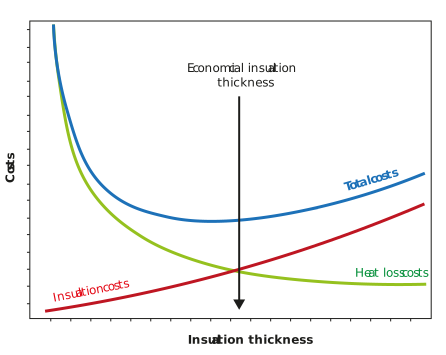
Figure: Trade-off of insulation costs versus energy saving
The figure above refers to insulation thickness, but there are also other costs involved, such as installation costs.
Insulation can contribute to the corrosion and care needs in this regard. We will not be going into the details here, but it is important to remember that in certain applications vapour barriers are required to shield materials from any condensation that may occur within the insulation. This is covered in the Heat Transfer unit. Another important factor that can contribute to corrosion is the leaching of chlorides from some insulation materials.
Let us now consider a few common insulation materials and their properties.
-
Mineral wool (also known as rock wool) is a composite made up of mineral particles such as stone or glass that are melted at high temperatures and are then spun together to form woollike fibres.
-
Glass wool is made from glass fibres that are made by melting glass and spinning it into fibres.
Mineral wool and glass wool have the best fire resistance of all the insulation options because they are inorganic. Glass wool is cheaper than mineral wool but is slightly inferior in all other aspects. Mineral wool can even be used as a ‘fire stop’. In a brewery, mineral wool is used in most of the ‘hot’ applications such as the insulation of brewhouse vessels, steam and hot water piping.
-
Polystyrene is a thermoplastic used as insulation in both extruded and expanded forms.
-
Polyurethane is a thermoset made from polyalcohols and isocyanates. It comes in two main forms: PUR, which is standard polyurethane and PIR which, is polyisocyanurate. These differ in the ratios of the input materials.
-
Phenolic foam is made from phenol-formaldehyde resin.
For cold applications, PUR and PIR are used with the preference being for PIR due to its better fire resistance rating. Polystyrene is avoided in larger application because of its poor fire resistance. However, if you are in a very small craft brewery, it may be a suitable form of insulation as the volumes used are then relatively low.
So how do these compare? The following table shows the relative performance of these materials. The insulation effectiveness is given for the same thickness of material. The cost is given relative to the same effective insulation value.
Table: Insulation properties
|
Material |
Fire resistance |
Insulation effectiveness |
Cost |
High Temperature Operation |
Vapour resistance |
|
Mineral Wool |
Excellent |
Fair |
Medium |
Excellent |
Poor |
|
Glass wool |
Excellent |
Fair |
Low |
Excellent |
Poor |
|
Polystyrene |
Poor |
Poor |
Low |
Poor |
Good |
|
PUR |
Poor |
Good |
High |
Fair |
Excellent |
|
PIR |
Fair |
Good |
High |
Good |
Excellent |
|
PF |
Good |
Good |
Very High |
Good |
Excellent |
We may wonder why we do not use rock wool in all applications; the poor resistance to vapour is the main reason for not using it for cold applications.