
Lesson 4 - Materials Application in Brewing
In this lesson we will discuss materials and their application in greater detail. This will include understanding their properties, advantages and disadvantages, and their main applications in the brewery. We will place emphasis on the materials most common in the brewing industry.
Other Ferrous Metals
Now that we have thoroughly reviewed stainless steel, we can consider the other ferrous metals. Although not widely used in the brewery, other than for structural applications, it is worth having a basic knowledge of these metals.
Cast iron
Alloys of iron with a carbon content above 2% are cast irons. There are a wide variety of cast irons such as grey cast iron, ductile iron, and white and malleable iron.
The main advantage of cast iron is that it is castable, meaning that it can be melted and poured into a form. Some cast irons are machinable, meaning that once cast they can be cut and shaped by metal machining tools. A downside is that cast iron can be brittle, especially in cold conditions.
Cast iron is often used for pump casings and certain valves. For some applications, like heat exchanger frames, cast iron can be used if it is clad with stainless steel. However, it is not used in process applications.
Carbon steel
Carbon steels are classified by the carbon content in the steel. The following table shows the four types of carbon steel.
Table: Types of carbon steel
|
Type |
Carbon content |
Properties |
Typical applications |
|
Mild and low carbon steel |
0.16-0.29% carbon |
Low cost, malleable |
Fences, gates |
|
Medium carbon steel |
0.30-0.59% carbon |
Good balance between ductility and strength, good wear resistance |
Structural steel, walkways, railings, dry applications |
|
High carbon steel |
0.60-0.99% carbon |
Very strong |
Springs, cutting tools |
|
Ultra-high carbon steel |
1-2% carbon |
Can be tempered to great hardness, use for specialised products |
Knives, axles, punches |
In general, carbon steel can be easily formed and welded.
Mild steel is well suited for use in dry environments. For this reason, it is used in the brewery extensively in the handling of dry raw materials, such and malt and other grains.
All carbon steels have the disadvantage of being susceptible to corrosion. One way around this has been to galvanise mild steel.
Galvanised steel
Mild steel is often galvanised by zinc plating to help it resist corrosion. Galvanised steel is resistant to corrosion from water, but not from alkaline and acidic products. Thus, in the brewing environment galvanised steel is not used in contact with product and cleaning liquids such as caustic and acid. Other than its wide use for equipment supports, walkways, railings, and building structures, galvanised steel plates are also used for silos to store barley, malt and other grain. Have a look at the photo below. Traditionally silos were built from concrete, but today the majority of new installations are done in steel due to lower costs and far quicker installations.
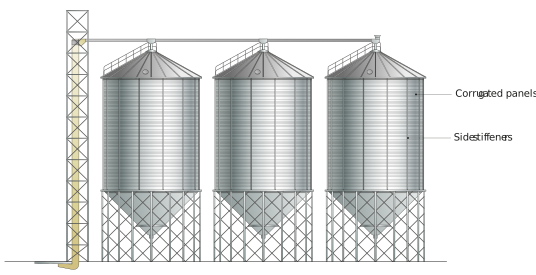
Figure: Corrugated galvanised steel grain silos
Alloy steels
Alloy steels contain varying amounts of different metals and materials that have been added to specialise their applications. Some of the most common additions are chromium, molybdenum, nickel, and silicon. The table below shows the effects of adding these. Generally, alloy steels are not used in brewing other than for very specialised requirements, such as shafts and gears.
Table: Common additions to alloys
|
Element |
% of Total Alloy |
Application |
|
Chromium |
0.5-2% 4-18% |
Increase hardenability Increase corrosion resistance |
|
Molybdenum |
0.25-0.4% |
Increase toughness |
|
Nickel |
2-5% 12-20% |
Increase toughness Increase corrosion resistance |
|
Silicon |
0.2-0.7% >2% |
Increase strength Increase magnetism |
Now that we have learnt about ferrous metal take some time to consider what would be the best ferrous metals to use in different applications in the brewery. When would you use stainless steel and when would you consider other ferrous metals? Give yourself 5-10 minutes to think about this, and then click ’Next’ to continue with this lesson.