
Lesson 4 - Materials Application in Brewing
In this lesson we will discuss materials and their application in greater detail. This will include understanding their properties, advantages and disadvantages, and their main applications in the brewery. We will place emphasis on the materials most common in the brewing industry.
Non-ferrous Metals
We have learnt about ferrous metal thus far, so now let us explore the most commonly used non-ferrous metals. Several other metals also have a role to play.
Copper
Copper is found in both a pure form and in its alloys. Brass in an alloy of copper and zinc.
It has a main advantage over stainless steel in that it has good thermal conductivity and is therefore well suited to heating applications. This same feature makes it well suited to uses in evaporators and condensers.
Whilst it does not have the strength of steel, it is malleable and easy to work with.
Copper is also thought to have excellent antibacterial properties. The exact mechanism of this is not clear, although a few theories have been put forward with regard to the effect it has on cellular permeability and metabolism (which we will leave to the microbiologists to clarify).
It is reasonably corrosion resistant. However, it does react with strong alkaline detergents, sodium hypochlorite, acid, and salty food, and this can cause unacceptable changes in taste.
Traditionally used for brewing vessels, and although now mainly used for cladding, it is still in use in some breweries; the biggest and most famous of which is for brewing ‘Pilsener Urquell’. Copper is often used as a sacrificial ion in stainless steel brewing vessels to reduce the concentration of sulphidic and sulphitic compounds. It is also widely used for small bore water pipes in household application.
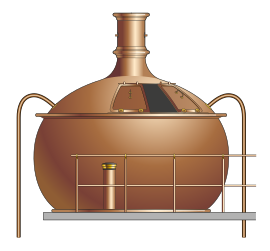
Figure: Old copper brewing vessel
Aluminium
Aluminium is normally used as a coating of anodised aluminium. Optimum resistance to corrosion is provided by an anodised layer in the region of 24 µm thickness.
Anodised aluminium is resistant to many inorganic chemicals in a pH range between pH 4-8.5. It is lightweight and strong. Welding is very difficult compared to steel, and pitting tends to occur in aerated chloride solutions.
Aluminium is typically used in motor housing in the brewery. Care needs to be taken if it is in an environment where caustic leaks can occur, for example, during CIP.
Titanium
Titanium is practically inert because the titanium surface is passivated by the formation of a strongly adhering layer of titanium dioxide on the surface. This passivity is not affected at high temperatures even when in contact with hypochlorites, bleach chemicals, and highly concentrated salt and acid solutions. This makes titanium extremely resistant to crevice corrosion, pitting and impingement. Impingement is a form of corrosion where the passive layer is destroyed through erosion by fluids or even cavitation. Unfortunately, titanium is very expensive.
In these cases, the increased life expectancy of the titanium plates over stainless steel plates can justify the additional capital expenditure.
Other metals
Although we have covered the main metals that are used in a brewery already, it is important also to list what metals should definitely not be used. For food safety reasons, toxic metals such as lead, cadmium and mercury should absolutely be avoided in food contact materials.
Zinc is easily dissolved in diluted acids and by bases. It also reacts with steam to produce zinc oxide and hydrogen gas. Zinc often contains trace amounts of the toxic metals cadmium (0.01-0.04%) and lead as impurities.
We now have an understanding of many of the properties of common ferrous and non-ferrous metals. So, let us now continue to our next subject, polymers.