
Lesson 4 - Materials Application in Brewing
In this lesson we will discuss materials and their application in greater detail. This will include understanding their properties, advantages and disadvantages, and their main applications in the brewery. We will place emphasis on the materials most common in the brewing industry.
Polymers: Thermoplastics
Polymers are playing an ever-increasing role as a material of construction in the food and beverage industry.
Let us first recall what we discussed in the Materials and Classification lesson about polymers. They cover a wide range of materials from engine oil to wood. As a material of construction, we will only focus on these three subclasses:
-
Thermoplastics (generally what we refer to as plastics)
-
Thermosets
-
Elastomers
Polymers are produced by a chemical reaction called polymerisation. Many processing aids and catalysts are used in these reactions, so it is important to know how the specific polymer was manufactured, and whether it qualifies as a food-grade material. There are international regulations, and sometimes specific local regulations, that deal with this.
In this section, we will focus only on the thermoplastics widely used in the brewery.
Thermoplastic polymers are polymers that soften when heated and can be reshaped. This can repeatedly happen with minimal degradation of the polymer.
Let us look at some of the common thermoplastics.
Polytetrafluoroethylene (PTFE)
PTFE is a polymer of tetrafluoroethylene. It is used extensively in Teflon coatings. What properties can you guess it has, due to its use in frying pans? High temperature, hard and non-stick are a few that come to mind. In more scientific terms it is very hydrophobic and has one of the lowest friction coefficients of known solids.
PTFE is so non-stick that not even a gecko can stick to it!
In addition to its low friction coefficient, it is virtually inert to all known chemicals and has a very large working temperature range of -270 to 260 °C.
PTFE cannot be cross-linked because of its chemical inertness. This is essentially what makes it a thermoplastic and not an elastomer. This lack of cross-linking results in it not having a ‘memory’.
PTFE is widely used for gasket and seal applications in difficult environments. Valves with PTFE liners are often used in the brewhouse because it is resistant to chemicals and high temperatures.
Polyvinylchloride (PVC)
PVC is one of the most common plastics. It is a polymer made from vinyl chloride monomers. To make it more flexible, plasticisers such as phthalates, are sometimes added. It was accidently discovered by a German chemist!
PVC is strong, has good chemical resistance and performs well at low temperatures.
However, it does not perform well at temperatures above 80 °C and has increasingly been controlled in food applications due to the concerns regarding health implications of phthalates.
Consequently, in brewing, it is mostly used in drainage and sewer applications.
A variation of PVC is chlorinated PVC, known as CPVC. It is more resistant to higher temperatures and is increasingly being used for water piping.
Polyethylene (PE)
Polyethylene was also discovered by accident!
It is a thermoplastic polymer of ethylene. The two most common varieties are low-density polyethylene (LDPE) and high-density polyethylene (HDPE). Whilst LDPE is mostly used for packaging and bags, HDPE has a far wider use.
HDPE is smooth, has high ductility and impact resistance. It has a reasonable temperature range enabling it to withstand temperatures of up to 180 °C and down to -50 °C. It has excellent chemical resistance to acids and bases – absorbing very little water. HDPE lends itself well to moulding and welding.
It is not, however, a high strength material, and is permeable to gases such as oxygen and CO2.
Whilst not used that much in large scale applications, HDPE tanks are used as fermenters by home and small-scale craft brewers. HDPE tanks are also used as flowtainers (typical 1000 L bins used for delivering mainly chemicals which may also be known as IBCs) for some brewing ingredients and chemicals. Because of the lower strength, these tanks are also limited in size.
Polypropylene (PP)
Polypropylene was apparently not discovered by accident, or maybe the accidental discoverer was too embarrassed to admit it was an accident.
It is very similar to polyethylene. However, it is harder and stiffer, with good wear resistance. It can withstand temperatures of up to 110 °C and has good chemical resistance to acids and bases. It is not as smooth as polyethylene, and has a slightly higher tendency to absorb water.
In the brewery, polypropylene is used in mash and beer filter plates as shown in the figure below.
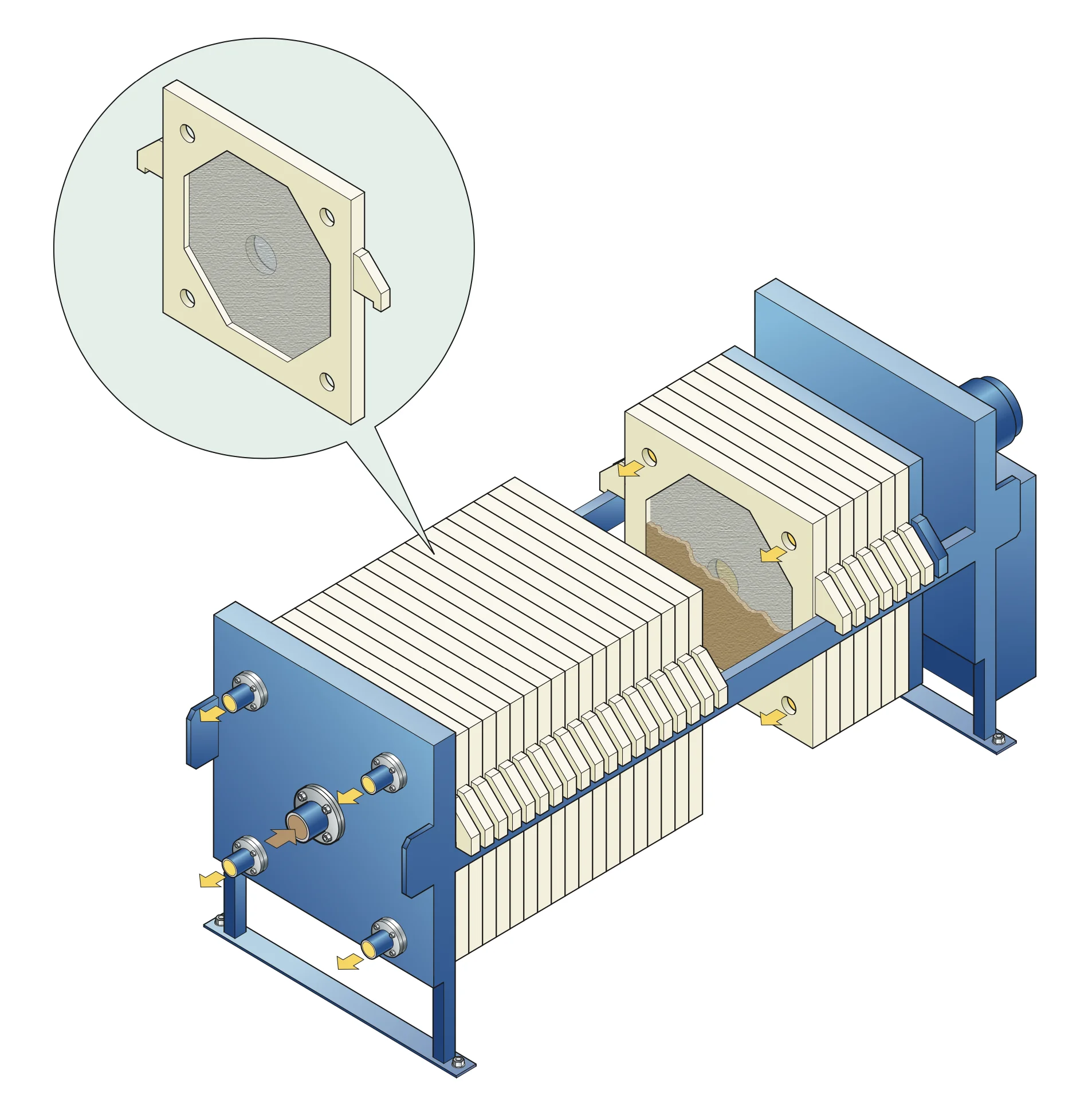
Figure: Polypropylene filter plates
Polycarbonate (PC)
Polycarbonates are polymers containing carbonate groups. They are mainly a product of the reaction of bisphenol A (BPA) and phosgene. Many water bottles are made from them, and these days most of them come with a BPA free sticker attached due to the health concerns with BPA.
Plastics containing BPA are banned for use with foodstuffs in France.
Polycarbonates can be optically clear, and their optical properties are superior to most other products, including most forms of glass. It is extremely durable and impact resistant, and has good hardness and stiffness; however, it is not abrasion resistant. It can withstand high temperatures up to 140 °C, and moderately low temperatures of down to -20 °C. In the brewery, it can be used for sightglasses and also for safety enclosures. One disadvantage is that it does not tolerate concentrated alkalines very well.
Polycarbonate is so strong that it is used as see-through burglar bars on windows.
Table: Chemical and physical properties of thermoplastics (adapted from Moerman & Partington)
|
Material of construction |
Chemicals conditions |
Physical conditions |
|||||||||||||
|
|
Mild alkaline |
Alkaline |
Strong alkaline |
Alkaline +NaOCl |
Mild alkaline disinfectant |
Salt water |
Chlorides |
Acid |
Acidic liquids |
Wet environment |
Steam |
Hot water |
Cold - below -20 °C |
Ozone |
|
|
Thermoplastics |
Teflon (PTFE) |
3 |
3 |
3 |
3 |
3 |
3 |
3 |
3 |
3 |
3 |
3/2 |
3 |
3 |
3 |
|
Polyvinylchloride (PVC) |
3 |
3 |
3 |
3 |
3 |
3 |
3 |
3 |
3 |
3 |
1 |
2 |
0 |
3/2 |
|
|
Polyethylene (PE) |
3/2 |
3/2 |
3 |
3 |
3 |
3 |
3 |
3 |
3 |
3 |
0 |
3/2 |
1 |
2/1 |
|
|
Polypropylene (PP) |
3 |
3 |
3 |
3 |
3 |
3 |
3 |
3 |
3 |
3 |
2 |
3/2 |
1 |
0 |
|
|
Polycarbonate (PC) |
0 |
0 |
0 |
0 |
3 |
3 |
3 |
1 |
2/1 |
2 |
1 |
2/1 |
1 |
2/1 |
|
|
Resistance value |
Suitability |
Resistance |
|||||||||||||
|
3 |
Constant, ongoing use |
High resistance |
|||||||||||||
|
2 |
Constant, conditional use |
Good resistance |
|||||||||||||
|
1 |
Limited use |
Low resistance |
|||||||||||||
|
0 |
Not usable |
No resistance |
|||||||||||||
Acrylonitrile Butadiene Styrene (ABS)
ABS is used as a pipe material for cold or warm water services. It has a recommended maximum duty temperature of 70˚C. It is widely used for water and waste water pipework and as a drainage material.
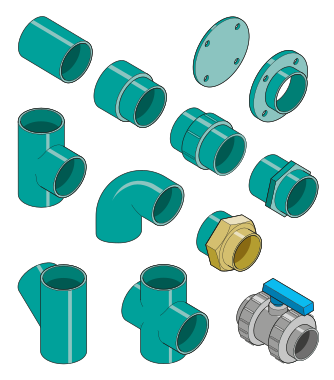
Figure: ABS fittings
ABS is assembled using a simple glue weld, making it quick to install.
LEGO® is made from ABS (acrylonitrile butadiene styrene), a thermoplastic polymer comprised of three monomers.
LEGO® make 20 billion bricks each year and according to the Guinness Book of World Records they produce more plastic tyres than anyone else.