
Lesson 4 - Materials Application in Brewing
In this lesson we will discuss materials and their application in greater detail. This will include understanding their properties, advantages and disadvantages, and their main applications in the brewery. We will place emphasis on the materials most common in the brewing industry.
Polymers: Thermosets and Elastomers
We shall now continue on from the previous page by learning about polymers that are in use in the brewery. In this section we will focus on thermosets and elastomers.
Thermosets
Thermosets are cured plastics. ‘Cured’ means that the polymer chains in them are intensively cross-linked, so that they can no longer be softened and reshaped at higher temperatures. The illustration below shows you what cross-linking does. It turns the ‘polymer spaghetti’ into a rigid solid substance.
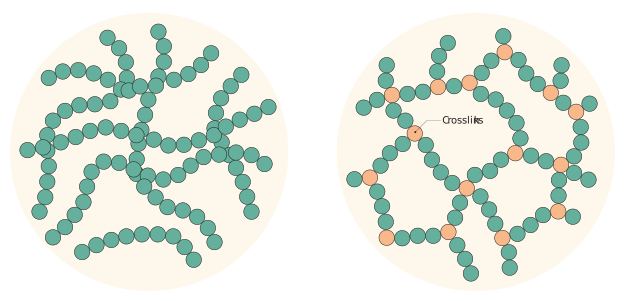
Figure: Cross-linking of polymers to form thermosets
Thermosets form into a rigid, hard, heat and solvent resistant solid.
Even though thermosets are generally stronger and stiffer than thermoplastics, they are still highly elastic, even at high temperatures. The properties of thermoset resins can be improved with the addition of fillers. Sometimes fillers are added to give the thermosets extra strength. We will only look at two types of thermosets that are extensively used; epoxy resins and polyurethanes.
Epoxy resins
Epoxies are normally formed by a cross-linked resin that is reacted with a hardener to produce a hard, chemical and solvent resistant material.
Epoxies are quite often reinforced with fillers such as fibres, quartz, glass beads, chalk, and even coal.
Advantages
-
Low moisture absorption – limits shrinkage, good dimensional stability
-
Epoxy resins have high strength
-
Good hardness and abrasion resistance
-
Cold cured epoxy resins are resistant to alkalis, diluted acids and alcohols
-
Odourless, tasteless and non-toxic
Disadvantages
-
Not resistant to strong oxidising substances
A very common use of epoxy resins is for flooring. As we can see, the advantages listed above are perfect for flooring in a wet high-wear environment.
Polyurethanes
Polyurethanes come in a variety of different materials. Two important applications in brewing are for flooring and cold insulation.
Polyurethane floor coatings are similar to epoxy resins. They are, however, softer, which has both advantages and disadvantages. They take impact better but can be scratched more easily.
The other extensive use for polyurethanes is for cold insulation materials. Insulation is often overlooked in materials of construction but a large variety of products are available for it. We will look at it in more detail at the end of this lesson in order to have it all in one place. For now, we will continue onto elastomers.
Elastomers
In this section, we learn about another category of polymers – elastomers. Elastomers are polymeric materials that can be substantially deformed under stress but rapidly recover, almost to their original form, when the stress is released.
The most important use of elastomers is as seals and gaskets.
The following table shows the most important properties of common elastomers.
Table: Chemical and physical properties of elastomers (adapted from Moerman & Partington)
|
Material of construction |
Chemicals conditions |
Physical conditions |
|||||||||||||
|
|
Mild alkaline |
Alkaline |
Strong alkaline |
Alkaline +NaOCl |
Mild alkaline disinfectant |
Salt water |
Chlorides |
Acid |
Acidic liquids |
Wet environment |
Steam |
Hot water |
Cold - below -20 °C |
Ozone |
|
|
Elastomers |
Nitrile rubber (NBR) |
2 |
2 |
2 |
2 |
3 |
3 |
3 |
1 |
2/1 |
3 |
0 |
2 |
2 |
1 |
|
Silicone rubber |
3 |
3 |
3/2 |
3 |
3 |
3 |
3 |
2 |
2 |
3 |
1 |
3 |
3 |
3 |
|
|
EPDM |
3 |
3 |
3 |
3 |
3 |
3 |
3 |
2 |
2 |
3 |
3/2 |
3 |
3 |
3 |
|
|
Perfluor-elastomer (PFE) |
3 |
3 |
3 |
3 |
3 |
3 |
3 |
2 |
3/2 |
3 |
3 |
3 |
1 |
3 |
|
|
Styrene butadiene rubber |
3 |
3 |
2 |
3 |
3 |
3 |
3 |
2 |
3/2 |
3 |
1 |
3 |
3 |
0 |
|
|
Resistance value |
Suitability |
Resistance |
|||||||||||||
|
3 |
Constant, ongoing use |
High resistance |
|||||||||||||
|
2 |
Constant, conditional use |
Good resistance |
|||||||||||||
|
1 |
Limited use |
Low resistance |
|||||||||||||
|
0 |
Not usable |
No resistance |
|||||||||||||
Choosing the right gasket or seal has to be done in line with the process conditions. For example: in selecting heat exchanger gaskets we need to take into account the typical operating temperatures and the type of liquids it will be exposed to. We may also want to choose a different type if the heat exchanger needs to be opened frequently for inspections.