
Lesson 4 - Materials Application in Brewing
In this lesson we will discuss materials and their application in greater detail. This will include understanding their properties, advantages and disadvantages, and their main applications in the brewery. We will place emphasis on the materials most common in the brewing industry.
Stainless Steel
When it comes to the food and beverage industry, no material is more commonly used than stainless steel. Steel is considered to be stainless steel only if it contains more than 11% chromium. Stainless steel owes its names to... being stainless.
Stainless steel was originally called rustless steel. However, the inventor wanted to market it for use as cutlery, and rustless just did not sound right.
Why is stainless steel so corrosion resistant? The corrosion resistance of stainless steel comes from a ‘passive’, chromium-rich, oxide film that forms naturally on the surface of the steel. Although extremely thin at just 1-5 nm, this protective film adheres strongly. It is chemically stable (referred to as ‘passive’) under conditions which provide sufficient oxygen to the surface. This passive state is its normal condition.
The key to its durability and corrosion resistance is that when the film is damaged, it normally repairs itself, provided there is sufficient oxygen for the oxidisation reaction to take place. Under certain conditions, the passive state can be broken down, resulting in corrosive attack. If the film is destroyed, the surface is in the active state. The passive layer can be destroyed during welding with an inert gas. The term ‘pickling and passivating’ refers to the process of restoring this layer.
Stainless steels’ main disadvantage is poor thermal conductivity.
However, stainless steel has many general advantages, including:
-
Corrosion resistance
-
No brittleness at very low (cryogenic) temperatures
-
Maintains strength at high temperatures, this varies across different types
-
High strength vs mass
-
Easy to clean
-
Aesthetic appearance
-
No contamination from heavy metals in the steel
-
Material discharges easily from stainless steel hoppers due to the microstructure of stainless steel. This essentially means the ‘grains’ of steel in stainless steel are smaller and smoother than with carbon steel. This smoothness allows materials to slide better across the surface.
-
Wet and dry abrasion resistance due to the microstructure of stainless steel
Classification of stainless steel
There are many grades of stainless steel, and they are divided into categories based on their composition and structures.
Stainless steel is a metal alloy. As we learnt earlier, it is defined as having a chromium content of 11% or higher. Steel also contains carbon.
Within these plain forms of stainless steel, we can differentiate between martensitic stainless steels, which have relatively high levels of carbon, and ferritic stainless steels, which have relatively low levels of carbon.
However, in addition to chromium and carbon, many other elements make up stainless steel, such as nickel, molybdenum, silicon and aluminium.
By adding nickel, austenitic stainless steel is formed. These have low or very low carbon contents. A lower grade of austenitic stainless steel can be made by replacing some of the nickel with manganese.
A special hybrid stainless steel can be formed by adding higher levels of chromium, but not as much nickel. These are known as duplex stainless steels because they have the properties of austenitic and ferritic stainless steels.
Within all these types, further additions such as titanium can be made to improve corrosion resistance.
The table below gives the most common examples, advantages and disadvantages of the four main classes of stainless steel.
Table: Comparison of different classes of stainless steel (SS)
|
Group |
SS types |
Basic composition |
Properties |
|
|
Advantages |
Disadvantages |
|||
|
Ferritic |
430 409 3CR12 |
12-18% chromium
Lower carbon content than Martensitic |
Moderate to good corrosion resistance (resistance increases with chromium content)
Magnetic
Good strength, cannot be hardened so must always be used in the annealed (heat treated) form |
Moderate to poor weldability, only thin gauge material is welded (approximately 3 mm), other than 3CR12 that is weldable to up 30 mm |
|
Austenitic |
304, 304L 316, 316L 321 317 |
18% chromium
8% nickel (changes crystal structure)
2-3% molybdenum
0.08% maximum carbon
0.03% carbon in L grades
Stabilised grades include titanium or niobium to combat weld decay zone |
Excellent corrosion resistance
Very hygienic and easy to clean important in brewing industry)
Easily fabricated and formed, good weldability
Easily hardened by cold work, but not by heat treatment
Non-magnetic
Wide temperature range, from cryogenic temperature up to 925 °C |
Only suitable for low concentrations of reducing acids
Crevice corrosion occurs in shielded areas and crevices
Halide ions, especially chlorine (Cl-), can break down the passive film |
|
Duplex |
2304 2101 2205 2507 |
21-26% chromium
3-8% nickel
3-5% molybdenum |
Extremely resistant to stress corrosion cracking
Resistant to acids, chlorides
Temperature range -50 °C-300 °C, can still be stretched to -80 °C
Good weldability Twice the yield strength of austenitic and ferritic stainless steels Magnetic |
More difficult to form and machine than austenitics
Higher price than austenitics
|
|
Martensitic |
410 420 431
|
12-18% chromium
Relatively high carbon content, 0.2-1.2% carbon |
Strength and hardness from high carbon content and can be hardened by heat treatment
Moderate corrosion resistance
Magnetic |
Very poor weldability because of high carbon content and hardenable nature |
Let us now look at a few common varieties of stainless steel and where they are used in a brewery.
3CR12 (a ferritic stainless steel) provides high strength and abrasion resistance. It has potential uses in material handling, especially for sugar and abrasive materials. Because of its resistance to wet applications, it can also be used for applications such as spent grain discharge and spent grain silos. It does not have the resistance to chemicals like austenitic grades, but it provides an affordable alternative to these.
Within the austenitic grades of stainless steel, SS304 and SS316 are by far the most common. If you were wondering, the L in SS304L and SS316L stands for low carbon. This provides better resistance to corrosion. SS304L is generally used for vessels, equipment and pipework where the temperatures are lower e.g. fermenters, storage vessels, bright beer tanks, and interconnecting pipework. SS316L is typically used in the brewhouse area. The photo below shows the typical shiny stainless steel vessels found in a brewhouse.
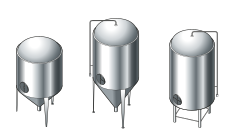
Figure: Stainless steel brewing vessels
Duplex stainless steels are used extensively for applications where higher temperatures and the presence of chlorides would lead to the corrosion of other grades of stainless. Like hot water storage tanks and hot de-aeration tanks for example.
For a larger list of stainless steels and their compositions, you can refer to the following article: