
Lesson 10 - Carbon Dioxide Recovery Technology
This lesson explores the technology used to recover and purify carbon dioxide (CO2), which is a co-product from brewery fermentations. Purified CO2 is used throughout the brewery to carbonate liquids and to purge air (oxygen) from vessels and packaging containers. It examines the role that fermentation and fermenter vessel operation has on the availability of CO2 for collection, as well as considering an overview of the technologies and plant involved in collecting, purifying, and liquefying CO2 for use back in the brewery.
Stripping (Distillation)
Not all plants have a stripper, but if one is present the gas is stripped (essentially distilled), to increase the purity of the CO2. This is a form of purification.
An option for plants where the purity of the liquefied CO2 (principally the dissolved oxygen) concentration may not be low enough for brewery use, is to use a stripper unit. This, essentially a distillation unit, will increase the concentration of the CO2 (or reduce the concentration of the impurities).
The analogy of an ethanol distillation system is possibly something we have more experience of, so let us use that in explaining the function of a CO2 distillation unit. In an ethanol distillation unit used to produce a concentrated ethanol-water solution (we are grossly simplifying the world of distilled products here), pure water has a higher boiling point (100 °C at sea level) than pure ethanol (78 °C at sea level). When we boil a mixture of ethanol and water, the first vapour that is boiled off is richer in ethanol. If we condense that vapour, we will have produced a liquid richer in ethanol than we originally had and that’s the concept of how we create a concentrated ethanol-water solution. So, how about a solution of CO2 and O2?
With a solution of CO2 and O2, pure CO2 has a higher boiling point (250 K at 18 bar) than pure O2 (130 K at 18 bar). When we boil a mixture of the two, the first vapour formed will be richer in O2. Conversely, the remaining boiling liquid mixture will be leaner in O2, i.e. we will have reduced the dissolved oxygen in the boiling liquid by boiling off some of the oxygen – purification!
A simplified schematic for this process is shown below.
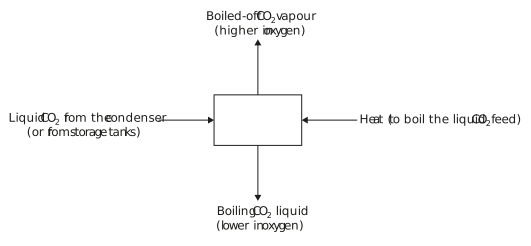
Figure: The purification of impure liquid CO2 by boiling
We can see two streams are coming from our boiling process: a vapour stream which is higher in oxygen and a liquid stream which is lower in oxygen.
Such a simple process is not normally efficient enough in removing sufficient quantities of oxygen from the boiling liquid. However, if we consider adding another boiling process (as shown below), then we would get an additional level of oxygen removal, i.e. better purification. Note that in this diagram, we have just one place where we only feed the liquid CO2 from the condenser (or storage tanks) at the top of process. However, we still have the purified liquid CO2 stream exiting at the bottom, and a single CO2 vapour stream, which is rich in oxygen, exiting at the top.
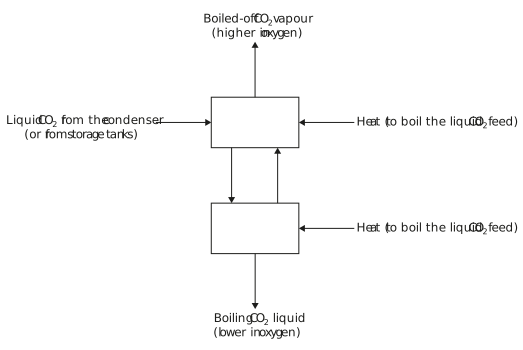
Figure: The further purification of impure liquid CO2 using two idealised boiling stages
If we take the idea of layering boiling processes on top of one another even further, until we get the required level of oxygen purification, then the most practical means of creating such a process is to use a packed column. This would typically have an equivalent stack upwards of ten single processes in a single column. Furthermore, we can include a single input of heat, at the bottom of the column, and have a single exit of oxygen-rich gaseous CO2 at the top of the column, as shown in the figure below. The figure also shows – in red – the CO2 gas feed, the incondensable vent, and the purified liquid CO2 lines to aid our understanding.
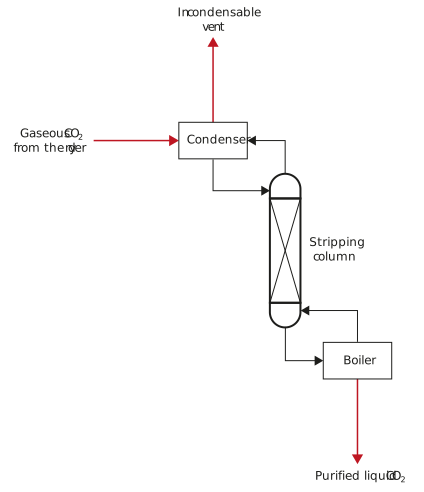
Figure: A simplified CO2 stripper unit