
Lesson 10 - Carbon Dioxide Recovery Technology
This lesson explores the technology used to recover and purify carbon dioxide (CO2), which is a co-product from brewery fermentations. Purified CO2 is used throughout the brewery to carbonate liquids and to purge air (oxygen) from vessels and packaging containers. It examines the role that fermentation and fermenter vessel operation has on the availability of CO2 for collection, as well as considering an overview of the technologies and plant involved in collecting, purifying, and liquefying CO2 for use back in the brewery.
Deodorising
Odours such as dimethyl sulphide, alcohols, and ketones are removed from the gas using activated carbon. This is a form of purification.
Deodorising, or the removal of aroma compounds, is done using an adsorbent (not an absorbent, as we mentioned in the washing step above).
It is essential to note the difference between adsorbents and absorbents.
Adsorbents work by using surface forces which bind molecules to their surface. Most commonly in CO2 deodorising, activated charcoal is used which is produced by roasting coconut husk to produce charcoal and then heating to around 1,000 °C with steam to activate the surface of the charcoal.
The adsorbent is held in a fixed bed within two generally identical vessels. The CO2 gas is usually fed upwards through the bed of one vessel and exits the vessel as a purified gas. Adsorbents have a fixed capacity for binding molecules to them and will eventually reach saturation, such that they cannot adsorb any additional molecules. At this point, the inlet gas is fed to the second vessel so that deodorising can continue.
The first vessel with a saturated adsorbent is then regenerated typically using steam to heat the bed and drive off the bound molecules. Once regeneration is complete, the vessel can be put on standby to be available for when vessel two, currently in service, becomes saturated. It should be noted that regeneration only drives off most, but not all, of the bound molecules. At the end of each regeneration cycle, the adsorbent capacity is slightly reduced. This back and forth between both vessels – one in service, whilst the other is being regenerated and then available on standby – continues until the adsorbent’s capacity (following regeneration) is too low for effective use. At this point, the adsorbent is either replaced or sent off-site for reactivation, which returns it to its ‘as-new’ capacity.
The arrangement of in service and standby vessels is shown in the figure below.
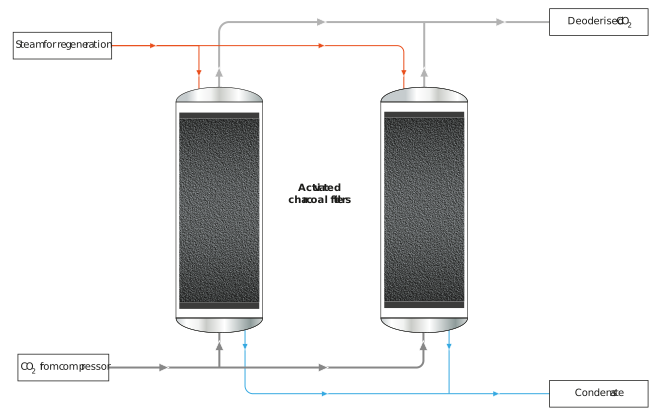
Figure: A pair of identical deodoriser vessels (one in service and one on standby)