
Lesson 10 - Carbon Dioxide Recovery Technology
This lesson explores the technology used to recover and purify carbon dioxide (CO2), which is a co-product from brewery fermentations. Purified CO2 is used throughout the brewery to carbonate liquids and to purge air (oxygen) from vessels and packaging containers. It examines the role that fermentation and fermenter vessel operation has on the availability of CO2 for collection, as well as considering an overview of the technologies and plant involved in collecting, purifying, and liquefying CO2 for use back in the brewery.
Washing (Scrubbing)
Washing the gas (also known as scrubbing) with water removes many of the water-soluble compounds. This is a form of purification.
Washing, or scrubbing, the CO2 with water involves contact between the two to ensure that water-soluble compounds, such as ethanol (and we will return in a moment to why ethanol is specifically mentioned here), are dissolved into the water, thereby removing them from the gas.
This close contact is achieved by using a countercurrent absorption column. It is straightforward when we break it down to the following:
-
Countercurrent – the gas and water flow in opposite directions to one another. The water flows downwards, and the gas flows upwards.
-
Absorption – (not adsorption) where one substance, water, dissolves another substance, for example, ethanol.
-
Column – the above processes take place in a closed column which contains ‘packing’, which increases the effective mass transfer area. This packing can take the form of small (approx. 10 to 100 mm diameter) spheres, or more complicated shapes (e.g. saddles or Raschig rings – worth looking up).
The diagram below shows a schematic of a washer/scrubber.
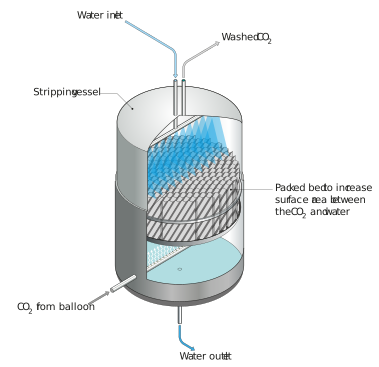
Figure: Scrubber (washer) schematic
Earlier, we specifically mentioned ethanol as a water-soluble compound present in raw CO2, which we want to remove during washing. The reason it was mentioned, besides its prevalence in beer, etc., is that its removal from raw CO2 is a means by which the washing or scrubbing efficiency is measured. Typical scrubbing efficiencies are in the range 85 to 95%, with high-efficiency scrubbers having values beyond 99%.
Some larger plants will include an additional washing tower prior to the water scrubber, with a dilute circulation of potassium permanganate to assist with the removal of nitrogen oxides and sulphur compounds.