
Lesson 10 - Carbon Dioxide Recovery Technology
This lesson explores the technology used to recover and purify carbon dioxide (CO2), which is a co-product from brewery fermentations. Purified CO2 is used throughout the brewery to carbonate liquids and to purge air (oxygen) from vessels and packaging containers. It examines the role that fermentation and fermenter vessel operation has on the availability of CO2 for collection, as well as considering an overview of the technologies and plant involved in collecting, purifying, and liquefying CO2 for use back in the brewery.
The Recovery Process and Plant
The process, and associated plant used to recover carbon dioxide, fulfils essentially two functions: purification and liquefaction (transforming the CO2 from a gas to a liquid). It is useful to remember these functions when considering each part of the recovery process and plant so that we do not get confused with the function of each piece of equipment. This can get slightly confusing because some parts of the recovery process have the function of both purification and liquefaction.
Let us start our consideration of the recovery process with an overview of the process and its various functions.
Recovery process overview
The route that the CO2 takes when being recovered can be summarised as follows:
-
Collection – the raw gas from each fermenter is piped from the fermenter to the collection main (covered in a previous section).
-
De-fobbing – the gas from the collection main may contain beer foam which has to be removed using a foam trap. This is a form of purification as it removes impurity, namely beer foam.
-
Balloon storage – we wish to eliminate any pressure and flow fluctuations in the collection main so that a steady supply of raw gas is produced. A flexible balloon is used to do this.
-
Washing – washing the gas (also known as scrubbing the gas) with water removes many of the water-soluble compounds. This is a form of purification.
-
Compression – by use of a compressor we increase the gas pressure to typically 18 bar g so that we can liquefy it at a later stage (we will look at the detail of this in a later section).
-
Drying – the gas is dried using a desiccant to adsorb the water moisture.
-
Deodorising – odours such as dimethyl sulphide, alcohols, and ketones are removed from the gas using activated carbon. This is a form of purification. This works similarly to activated charcoal impregnated insoles in our shoes which reduce odour. Likewise, an activated carbon cartridge in a cooker hood traps cooking smells; the above is the same principle.
-
Condensing – the gas is now cooled to around -20 °C and condensed or liquefied. Any incondensable gases, such as oxygen and nitrogen, are vented out of the condenser resulting in the liquefied CO2 increasing in purity. This is a form of purification and liquefaction.
-
Stripping – not all plants have a stripper but if present the gas is stripped, (essentially distilled), to increase the purity of the CO2. This is a form of purification.
-
Stored – the liquid CO2 is stored in a tank ready for use back in the brewery.
-
Vaporising – the liquid CO2 needs to be turned back into a gaseous form prior to use back in the brewery. This is done using a vaporiser which uses ambient air as a heating medium.
The diagram below summaries this process.
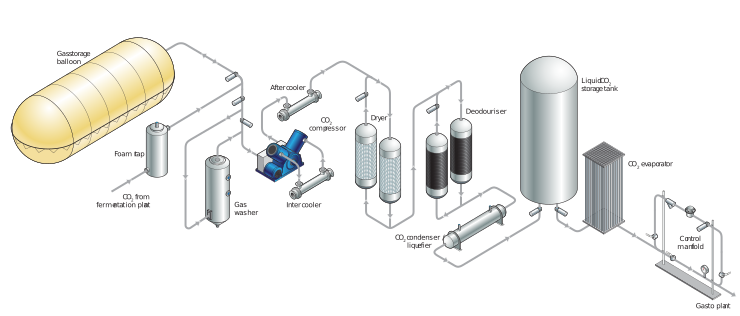
Figure: A schematic of a CO2 recovery plant
Let us now look at each of these processes in more detail and at some of the equipment used.