
Lesson 10 - Carbon Dioxide Recovery Technology
This lesson explores the technology used to recover and purify carbon dioxide (CO2), which is a co-product from brewery fermentations. Purified CO2 is used throughout the brewery to carbonate liquids and to purge air (oxygen) from vessels and packaging containers. It examines the role that fermentation and fermenter vessel operation has on the availability of CO2 for collection, as well as considering an overview of the technologies and plant involved in collecting, purifying, and liquefying CO2 for use back in the brewery.
Compression
Use of a compressor increases the gas pressure to typically 18 bar g so that we can liquefy it at a later stage (we will look at the detail of this in a later section).
Compressing the gas, i.e. increasing its pressure, is done to (later) allow the gas to condense using moderate amounts of cooling. While this might sound a little strange because we might expect that cooling any gas will cause it eventually to condense into a liquid, it is not quite that simple. Take a look at the figure below, which shows a pressure-temperature relationship for CO2 with the various phases of solid, liquid and gas demarcated.
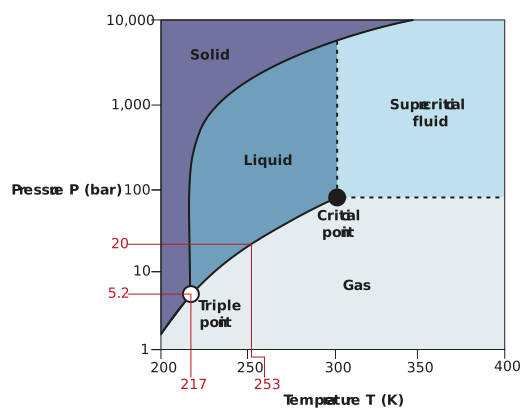
Figure: Pressure – temperature chart for CO2 showing differing phase regions
The first thing to notice from this figure is the presence of a point which is the intersection of all three phases, termed the triple-point (it is at the bottom left of the graph).
The triple-point for CO2 is 217 K and 5.2 bar a.
At the triple-point, the CO2 would exist quite happily, or in equilibrium, as a gas, a liquid, and a solid. We do not want our CO2 existing in all three phases at the same time, but rather only as a liquid when we cool it at a later stage. The triple-point tells us something important – we need to compress the gas to above 5.2 bar a for it to exist as a liquid at any temperature.
The second thing we notice is that we do not need to cool the gas as much, i.e. we do not need to reduce its temperature as much if we compress the gas to a higher pressure. In practice, typically 14-20 bar g is used (e.g. at 20 bar a, a condensing temperature of 235 K is required).