
Lesson 10 - Carbon Dioxide Recovery Technology
This lesson explores the technology used to recover and purify carbon dioxide (CO2), which is a co-product from brewery fermentations. Purified CO2 is used throughout the brewery to carbonate liquids and to purge air (oxygen) from vessels and packaging containers. It examines the role that fermentation and fermenter vessel operation has on the availability of CO2 for collection, as well as considering an overview of the technologies and plant involved in collecting, purifying, and liquefying CO2 for use back in the brewery.
Storage and Vaporisation
The liquid CO2 is stored in a tank ready for use back in the brewery, at which time it needs to be turned back into a gaseous form prior to use. This is done using a vaporiser which uses ambient air as a heating medium.
Simply put, the liquid CO2 from the condenser is stored in a pressurised tank, and when required for use in the brewery, the liquid is passed through a vaporiser (and boiled) to provide pressurised gaseous CO2 to the brewery users. As the liquid CO2 is under considerable pressure (14 to 16 bar g), this results in a boiling point (around 242 K) well below ambient temperatures. Ambient air can be used as a heating medium in warmer climates, or steam in colder ones. A diagram of an ambient air heated vaporiser is shown below.
Alternatively, a more energy-efficient approach, albeit with additional capital cost, is to use a heat exchanger to vaporise the liquid CO2 using the gaseous CO2 upstream of the condenser. In this way, the vaporising CO2 pre-cools the CO2 gas and reduces the condenser thermal load.
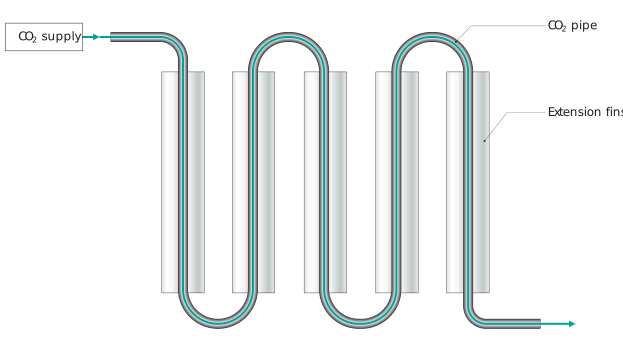
Figure: An atmospheric CO2 vaporiser with extended surfaces on the outside of the vertical pipes carrying the vaporising CO2