
Lesson 10 - Carbon Dioxide Recovery Technology
This lesson explores the technology used to recover and purify carbon dioxide (CO2), which is a co-product from brewery fermentations. Purified CO2 is used throughout the brewery to carbonate liquids and to purge air (oxygen) from vessels and packaging containers. It examines the role that fermentation and fermenter vessel operation has on the availability of CO2 for collection, as well as considering an overview of the technologies and plant involved in collecting, purifying, and liquefying CO2 for use back in the brewery.
De-fobbing – Foam Trap
The gas from the collection main may contain beer foam which has to be removed, or de-fobbed, using a foam trap. This is a form of purification as it removes an impurity, namely beer foam.
In larger ferment blocks, a single large foam trap is used, termed ‘the cellar foam trap’. Smaller cellars, and in some cases smaller fermenters, utilise a CO2 ‘lantern’ (also known as a dash pot), which is a small glass or Perspex vessel partially filled with water through which the CO2 bubbles. These lanterns are either attached to individual fermenters or connected to several fermenters at once. Any foam in the CO2 will dissolve in the water allowing the CO2 to leave the lantern devoid of foam. A schematic of a CO2 lantern is shown below.
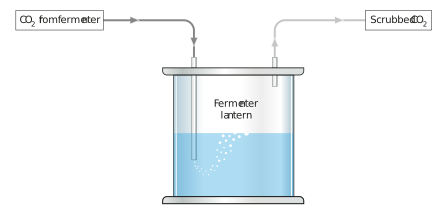
Figure: Fermenter lantern (or dash pot) showing the CO2 from the fermenter bubbling through a depth of water to disengage any foam present
A large cellar foam trap consists of a vessel, generally a vertical cylindrical vessel, which has a spray nozzle fitted at the top of the vessel which directs a spray of water downwards through the vessel. A body of water is kept in the base of the vessel. The raw CO2 gas enters underwater and flows upwards through the spray to exit at the top of the vessel. The combination of the gas entering under the body of water and passage through the spray ensures that any foam is dissolved into the water and/or knocked down by the spray and does not leave with the raw gas. The diagram below shows a schematic of this plant.
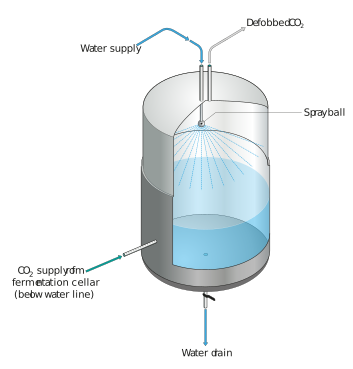
Figure: Cellar foam trap
It is worth noting that typically foam traps are not capable of operating under excessive fermenter fobbing conditions. All the safeguards of fermenter operation need to be still adhered to, e.g. adequate fermenter headspace, care to not overfill fermenters, and control over fermentation rate, etc.