
Lesson 10 - Carbon Dioxide Recovery Technology
This lesson explores the technology used to recover and purify carbon dioxide (CO2), which is a co-product from brewery fermentations. Purified CO2 is used throughout the brewery to carbonate liquids and to purge air (oxygen) from vessels and packaging containers. It examines the role that fermentation and fermenter vessel operation has on the availability of CO2 for collection, as well as considering an overview of the technologies and plant involved in collecting, purifying, and liquefying CO2 for use back in the brewery.
A High-level View of Carbon Dioxide Recovery
Before looking at the process of CO2 production and recovery in detail, we should first consider what is involved in CO2 recovery at a high level. There are three important technological aspects which we need to be clear about:
-
Fermentation: the biochemical reaction which produces carbon dioxide (as well as ethanol and flavour and aroma compounds).
-
Fermenter: the vessels within which fermentation takes place.
-
Fermenter block: a group of fermenters which cumulatively collect and supply carbon dioxide to the recovery plant.
These three technological aspects are shown schematically below.
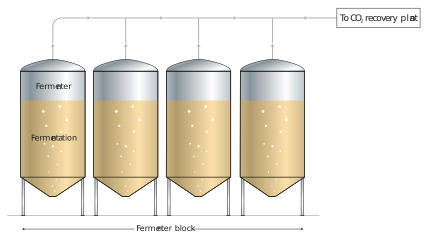
Figure: The differentiation of fermentation, fermenters, and a fermenter block
It may be unclear why we have given emphasis to fermentation, a fermenter, and a fermenter block. What we are trying to draw attention to is the following:
-
A fermentation, as a biochemical reaction, produces carbon dioxide which is released from the fermenting wort liquid volume. Representative reaction equations for fermentation are well understood and available. These allow us to quantify the amounts of CO2 produced during fermentation (we will look at this in a later section).
-
A fermenter emits CO2 once the gas has been released from the fermentation (literally from the fermenting wort), and once it mixes and displaces the gaseous headspace of the fermenter. This headspace is initially full of air following cleaning of the fermenter before filling. The initial gas emitted from the fermenter is very rich in air and lean in CO2, and as the fermentation progresses, the emitted gas becomes richer in CO2.
-
A fermenter block consists of several or often all fermenters in the brewery, where the CO2 gas emitted from all fermenters is collected in a common pipe and fed to the CO2 recovery plant. The consequence of collecting gases from all fermenters in a common pipe is that the gases mix together, both lean and rich in CO2.
The mass flow rate of collected gases from the fermenter block is the accumulation of all fermentation gases from all fermenters.
-
Fermentation is the biochemical process which produces CO2 (and other useful products).
-
A fermenter is a vessel within which fermentation takes place. It emits a mixture of fermentation gas and air, which increases in CO2 richness as fermentation proceeds.
-
A fermenter block is a group of fermenters which cumulatively collect and supply carbon dioxide to the recovery plant. The concentration of CO2 and flow rate is the accumulation of all fermentation gases from all fermenters.
Keeping these three distinct but related concepts at the front of our minds, let us now look at how a brewer can quantify the amount of carbon dioxide that fermentation, a fermenter, and a fermenter block can produce.