
Lesson 6 - Electricity
In this lesson we take a closer look at electricity from a utilities perspective. We will review the basics of electricity and consider the different forms (direct current and alternating current, single phase, and three phase) and voltages. The basic reticulation systems within the brewery will also be covered
Electrical Overload
Earth leakage is the result of a fault in the electrical system. Electrical overload is what happens when a circuit is used to power more than it was designed for.
Each circuit is normally designed by considering what will typically be used on it. Lighting circuits normally only have lights in them. As lights are all low power, we can have many lights on one circuit. Think of a typical house with 20 light bulbs. Old bulbs used to be 60 W, and now with modern LED lights 7 W is not uncommon. Thus, all the light bulbs in your house together will only draw between 150 W and 1200 W, depending on the type. Now compare this to a kitchen, which may have a kettle, an electrical stove, and a microwave operating. A typical kettle is 2 kW, and with the addition of the other equipment a circuit can quickly be overloaded if it was not designed properly.
So, what happens if we overload a system? Well the wiring is normally sized for a certain load. If this is exceeded, the wiring gets hot and could potentially melt the insulation and cause a short circuit and even a fire. In order to protect the system from this, overload circuit breakers are installed. These are called multiple circuit breakers (MCBs) and are the modern version of the fuse wire. Their main advantage is they can be switched back on simply once the overload situation has been resolved, whereas the fuse wire needed to be replaced with a new piece of wire.
Electrical isolation
Electrical isolation of equipment is required whenever electrical work is to be done on it. It is also required to ensure that equipment cannot be run whilst someone is doing maintenance on it or entering a vessel with an agitator in it.
For isolation to be considered safe, the following are essential:
-
The correct isolation point must be identified.
-
The means of isolation must be adequate.
-
The isolation must not be able to be removed whilst work is undertaken.
What do we mean by identifying the correct isolation point? Let us take the simple example of a light with a light switch. All the lights on a circuit share a common neutral wire, and only the live wire goes through the switch. Thus, if there is a fault on the circuit, switching the light off will not make it safe. You need to find the isolation point which ensures that the equipment is completely isolated. If this is not a routine and well-documented isolation, a test with an approved voltage detector should be done to ensure the point is isolated. Adequate means of isolation range from removing the power socket to using circuit breakers.
Maintaining isolation means that the isolation should be under the control of the person working on it. This often means locking the isolation in place and ensuring it is tagged to show that work is being done. The person carrying out the work should have sole control of the key. The figure below shows an example of a circuit breaker that has been locked out.
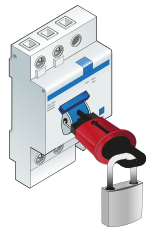
Figure: Isolation of a circuit breaker
For a more comprehensive guide to electrical isolation, see the link below. Note, this is for illustrative purposes only and is not a recommendation or endorsement of the supplier’s product.
https://www.electricalsafetyfirst.org.uk/media/1201/best-practice-guide-2-issue-3.pdf