
Lesson 6 - Electricity
In this lesson we take a closer look at electricity from a utilities perspective. We will review the basics of electricity and consider the different forms (direct current and alternating current, single phase, and three phase) and voltages. The basic reticulation systems within the brewery will also be covered
Electrical Motors
Electrical motors are used to convert electrical energy into mechanical energy.
Electrical motors can be quite complex, and there are a range of them. The most common form of an electric motor is the electric induction motor. In this motor, a current is applied to winding in a stator (the stationary part of the motor) which surrounds the rotor (rotational part of the motor). By applying the current, a magnetic field is induced in the stator winding and this also induces a small magnetic field in the rotor. The figure below shows a single-phase motor.
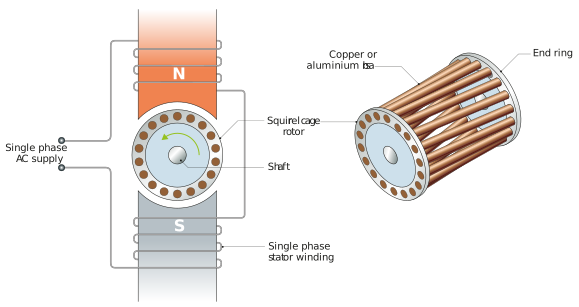
Figure: Typical single-phase motor
The magnetic fields induced in the windings and the rotor cage repel each other and this results in the rotation of the rotor. However, in single-phase motors this does not have any effect until rotation actually starts. To overcome this, a secondary winding is normally installed to provide a force to start the rotation.
Three-phase motors do not have this problem. That is because the three phases work together and create a rotating field. This results in the rotation of the cage. The following video gives a good explanation.
Another type of motor is a synchronous motor. This has a permanent magnet or electromagnet in it, so it does not rely on the induction effect.
For more information on synchronous motors, following the link below.
https://www.britannica.com/technology/electric-motor/Synchronous-motors
Motors also have different numbers of poles. A two-pole motor has two poles per phase.
The figure below shows how the windings would look in three-phase motors with different numbers of poles.
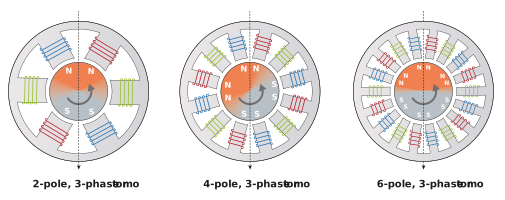
Figure: Two-pole, four-pole, and six-pole induction motors
As the number of poles increases, the rotational speed decreases proportionally. That is because the rotor now does not have to go as far around the stator to find the next peak in the rotational field.
For a frequency of 60 Hz, the current changes direction 60 times per second. Thus, a motor with one pair of poles (a two-pole motor) needs to follow that change 60 times per second, causing the rotor to turn 60 times per second. The motor speed will therefore be 3600 rpm. If a motor has two pairs of poles (a four-pole motor), the rotor only has to turn enough for the next set of poles to rotate into place. It then only has to rotate 30 times per second or at a speed of 1800 rpm. In the same way, we can show that a six-pole motor will rotate at a speed of 1200 rpm. The table below summarises this.
Table: Motor speeds for different numbers of poles and frequencies
|
Number of poles |
Speed at 50 Hz |
Speed at 60 Hz |
|
2 |
3000 rpm |
3600 rpm |
|
4 |
1500 rpm |
1800 rpm |
|
6 |
1000 rpm |
1200 rpm |
For induction motors, there is a slight lag between the change in the current direction and the induced effect in the rotor. Therefore, these motors do not reach the full speed calculated. As an example, a four-pole motor running at 50 Hz may only have a rated speed of 1440 rpm.