
Lesson 6 - Electricity
In this lesson we take a closer look at electricity from a utilities perspective. We will review the basics of electricity and consider the different forms (direct current and alternating current, single phase, and three phase) and voltages. The basic reticulation systems within the brewery will also be covered
Direct Current versus Alternating Current
Electricity comes in two forms, direct current (DC) and alternating current (AC).
DC is electricity that flows in a constant direction. It comes from a battery that has positive and negative terminals. This is what a battery-operated torch uses.
AC is where the polarity of the voltage and current switches direction. Most household equipment uses this, e.g. kettles, toasters, and electric shavers.
The figure below shows both circuits.
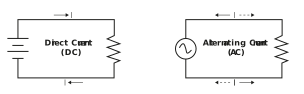
Figure: Typical DC and AC circuits
AC has a frequency which is measured in Hertz (Hz). One Hz means one oscillation per second. Electricity is supplied at 50 or 60 Hz in most countries.
The figure below shows the output of a DC supply versus an AC supply.
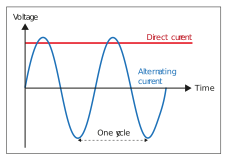
Figure: Output of DC versus AC circuits
So why does AC flow in a sinusoidal or sine wave form? The answer to this is in how it is generated. The figure below shows a basic AC generator where a wire loop is moved through a field.
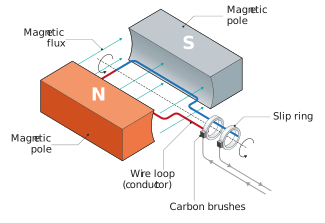
Figure: Basic AC generator
Let us now look at this in more detail. When the coil is perpendicular to the magnetic flux, no current results. As the coil moves, with the blue loop moving towards the north (N) pole, the current starts flowing in one direction. It is at its strongest when the coil is parallel to the field with the blue loop adjacent to the N pole. This current decreases as the blue loop moves towards the middle, and is zero when the loop is perpendicular to the magnetic flux. As the blue loop moves towards being adjacent to the south (S) pole, the current flows in the other direction. As the coil moves from parallel to the field to perpendicular, the current decreases.
This process produces a sinusoidal wave. The mechanisms of this are shown in the figure below.
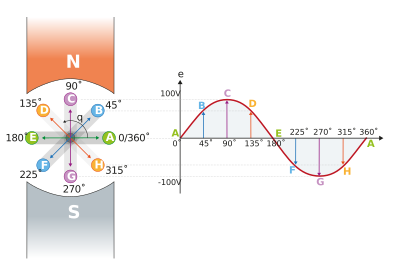
Figure: Generation of a sinusoidal wave
The positions here can also be related to the explanation above. The blue coil at position A is the starting point. Position C is adjacent to the N pole, position E is perpendicular, and position G is adjacent to the S pole.
There are many reasons why AC is so prevalent. These include:
-
Electricity is normally generated as alternating current.
-
AC is easier to transform to different voltages.
-
AC can be generated at far higher voltages.
So that explains why AC is commonly used for general power and households. However, in a brewery DC is also used. Let us look at why this is.
DC power in a brewery
DC also has some advantages:
-
DC power can be stored in a battery.
-
The power is relatively constant compared to AC which can fluctuate.
-
Solar energy generates DC power.
Breweries generally must be supplied by AC power because of the large equipment used, which requires greater voltages. However, you will also find DC power in many breweries. Many instruments are very sensitive and have delicate electronics on board. The Process Control Unit describes many examples of these types of instruments. Many of these devices use millivolts to send signals, so any fluctuation in power can have an effect. Having these operated by AC power is a bit like using a chainsaw to do surgery. DC also has another advantage in that it allows for back-up power systems to be relatively easy to use. In case a brewery’s main power fails, many systems have built-in uninterrupted power supplies (UPSs) which keep the control systems operational. Thus, DC definitely has its place in the brewery. The voltage used by most instruments is 24 V DC, although other voltages may be used.
Recent advances have produced some interesting options. DC is making a comeback, as options for high voltage DC systems are being developed and are in some instances more efficient at transmitting electricity than AC systems.
The competition between DC and AC was started by their inventors. Edison invented DC and Tesla invented AC.
To find out more about DC vs AC and how it all started, see:
https://www.energy.gov/articles/war-currents-ac-vs-dc-power
Keep in mind that the field generated by an AC power cable can have an influence on a neighbouring cable. That is why instrument and power cables are often run via different routes. If this is not possible, they can be shrouded.