
Lesson 6 - Electricity
In this lesson we take a closer look at electricity from a utilities perspective. We will review the basics of electricity and consider the different forms (direct current and alternating current, single phase, and three phase) and voltages. The basic reticulation systems within the brewery will also be covered
Single-phase versus Three-phase Power
The standard power supply in homes is single-phase AC power. However, in industry it is common to use three-phase power for many applications. With three-phase power, instead of having only one cable supplying power there are three.
Each cable is out of phase from the others by 120°. One complete cycle is 360° and the three phases are equally spaced from each other. The figure below shows how this works.
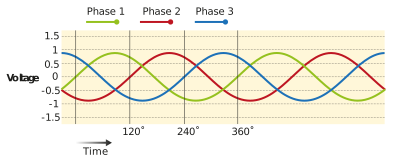
Figure: Three-phase power
If only single phase is used, then only the green line for phase 1 will be present.
So why do we use three-phase? Think of a large spinning wheel. Some playgrounds have these mounted horizontally and children sit on them whilst the adults push them. If you are only allowed to push it in one place, you will need to be quite strong. If, however, you can push it in three different places you can keep it going much more easily. The same goes for three-phase power. If it is powering a motor, there will be more constant power applied to the motor.
It is important to not get confused between the number of wires and the number of phases. Single-phase power requires two wires, and these are called the live and the neutral. The neutral wire is what is used to complete the circuit. Many cables include an earth wire, but that is not used for the circuit.
Three-phase power require three wires – one for each phase. Each wire carries the same power.
Three-phase power allows for more power to be carried, since three wires carry three times more power than the two wires for single-phase.
AC choices in a brewery
The choice between single-phase and three-phase power primarily has to do with the size of the equipment. For motors, the maximum recommended size for a single-phase motor is 1 kW
Now that we have had a look at the generation and types of electricity, let us have a quick look at electrical motors.