
Lesson 6 - Electricity
In this lesson we take a closer look at electricity from a utilities perspective. We will review the basics of electricity and consider the different forms (direct current and alternating current, single phase, and three phase) and voltages. The basic reticulation systems within the brewery will also be covered
Different AC Voltages and Phases
Different voltages are used in different countries and across different components. Electricity can also be single phase or three phase.
High voltages are used to transfer electricity across long distances, as this requires far smaller cables and lowers the losses which occur in the cables. These voltages are then ‘stepped down’ through a transformer or even a series of transformers.
So, what is a transformer? In basic terms, it is a piece of equipment that converts electrical power from one voltage to another. This is done by having the current run through a coil which then induces a current in another coil. The figure below shows a typical step-down transformer.
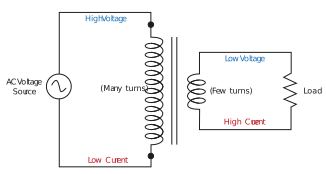
Figure: Typical step-down transformer
The voltage required is typically governed by the cost and availability of electrical equipment. The table below shows the most commonly used voltages and frequencies around the world.
Table: Commonly used voltages and frequencies in different countries
|
Country |
Single Phase Voltage |
Three Phase Voltage |
Frequency |
|
Australia |
230 V |
400 V |
50 Hz |
|
Brazil |
127 V / 220 V |
220 V / 380 V |
60 Hz |
|
China |
220 V |
380 V |
50 Hz |
|
France |
230 V |
400 V |
50 Hz |
|
Russia |
230 V |
380 V |
50 Hz |
|
South Africa |
230 V |
400 V |
50 Hz |
|
UK |
230 V |
415 V |
50 Hz |
|
USA |
120 V |
208 V / 240 V / 480 V |
60 Hz |
Europe decided on 50 Hz because it would fit into metric calculations easier.
Let us have a look at three-phase power next.