
Lesson 6 - Electricity
In this lesson we take a closer look at electricity from a utilities perspective. We will review the basics of electricity and consider the different forms (direct current and alternating current, single phase, and three phase) and voltages. The basic reticulation systems within the brewery will also be covered
Basics of Electricity
Electricity is defined as the movement of a charge. Essentially, it is the flow of electrons through a conductor.
Just as water does not flow unless there is pressure on it to do so, neither does electricity. The pressure that makes electrons flow is known as the electromotive force (EMF or E). The unit for this pressure is called a volt (V).
The amount of charge that is transferred is called the current (I) and the unit for this is an ampere (A). This is similar to the flowrate of a fluid in a pipe.
The resistance (R) to the flowrate is measured in Ohms (Ω). This is a function of the electrical equipment and the cabling or conductors used. Different materials, temperatures, and thicknesses all contribute to the overall resistance.
These are related by the most basic electrical law called Ohm’s law:

As you can see from the equation, for a given voltage the current will decrease as the resistance increases. This is similar to what happens to the flow of water in a pipe if the pressure drop increases.
The figure below shows a simple electrical circuit. Conventionally, flow is shown from the positive to the negative terminal, but in reality, it happens the other way around.
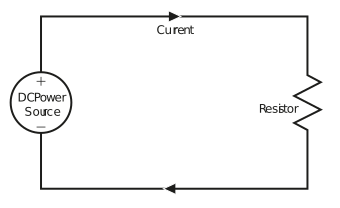
Figure: Simple electrical circuit
Another important concept is that of electrical work performed. Electrical work is measured in watts (W).
A watt is the unit of measure for power. Electrical power is the rate per unit of time at which electrical energy is transferred. It can also be seen as the rate at which work is performed.
The equation to define electrical power is:

So power is a measure of instantaneous output, such as how much water can be moved in a second. There are also mechanical power and thermal power. They all have slightly different definitions, but all are about how much work is done in a unit of time.
Typical power units for common household equipment range from 5 W for an LED light bulb to 2 kilowatts (kW) for a kettle. In a large brewery, some equipment goes up to hundreds of kWs.
Before we end this basic introduction, let us quickly look at one more concept: the kilowatt-hour (kWh). This is a measure of the total work performed. One kWh is the work performed when power at the rate of 1 kW is applied for one hour.