
Lesson 8 - Refrigeration Technology
This lesson takes a closer look at refrigeration technology. It reviews the different primary and secondary refrigerants and explores the technology required to deliver primary refrigeration to the brewery. It concludes by looking at how refrigeration is used within the brewery.
Primary Refrigeration System Configurations
There are a number of ways in which primary refrigeration systems can be put together.
Different configurations are used to either cater for the limitations of compressors, or to allow for different temperatures and improve COP.
Single-stage compression system
The simplest configuration is the single-stage compression system. This is the basic vapour compression cycle, which you learned about in the Refrigeration Theory and Cycle lesson. The following figure shows this circuit.
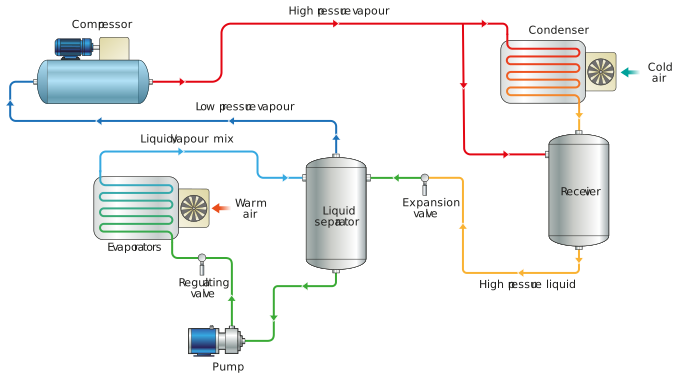
Figure: Single-stage compression refrigeration system
Two-stage compression system
In two-stage compression, we have an intermediate cooler between two compressors. Liquid refrigerant from the condensers passes through a coil inside the tank. A portion of refrigerant is also sprayed into the tank to provide a cooling effect. The intermediate pressure vapour from the first compressor is also passed through the tank, which cools it before it goes to the second compressor.
In this way, the compressor ratios are lower and the intermediate vapour is cooled.
The figure below shows a typical two-stage compression system.
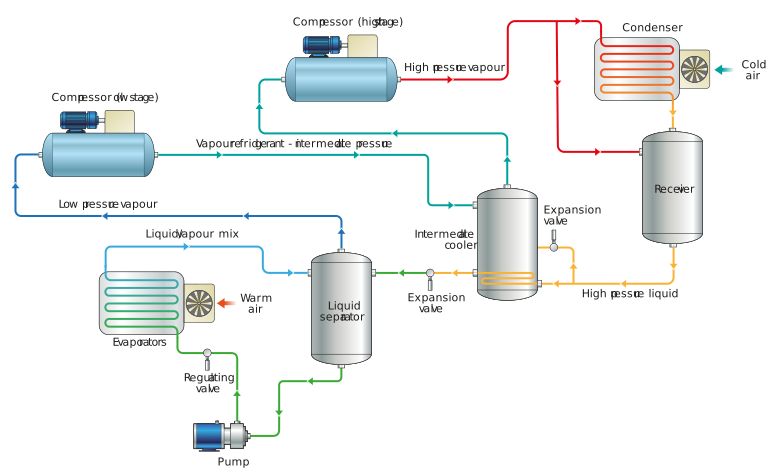
Figure: Two-stage compression system
This can also be shown using the Mollier diagram.
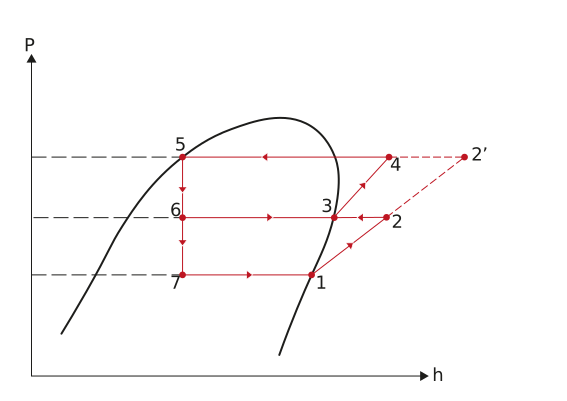
Figure: Mollier diagram for two-stage compression
Split refrigeration circuits
You will remember from the Refrigeration Theory and Cycle lesson that the evaporation temperature plays a huge role in determining the COP of the refrigeration plant. If this temperature is controlled by the lowest temperature required in the brewery, it typically has to run at -8°C. However, many processes require higher temperatures, and thus if the circuit was split, then one circuit could operate at a higher temperature.
Cascade compression systems
Cascade systems use the refrigeration generated in one circuit to perform the condensing in another circuit. This can considerably improve performance, especially in low temperature applications. The figure below shows an example of a cascade refrigeration system.
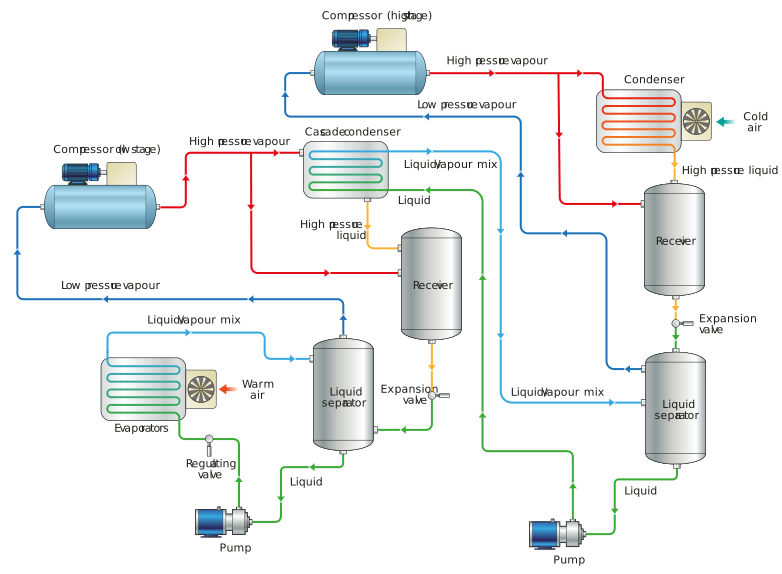
Figure: Cascade refrigeration system
Now that we have reviewed how to operate a refrigeration plant, let’s have a quick look at where refrigeration is used.