
Lesson 8 - Refrigeration Technology
This lesson takes a closer look at refrigeration technology. It reviews the different primary and secondary refrigerants and explores the technology required to deliver primary refrigeration to the brewery. It concludes by looking at how refrigeration is used within the brewery.
Condensers
Condensers remove heat from the high pressure vapour and condenses it into liquid. This is where the cooling effect comes from.
Condensers generally release this heat to the atmosphere and are dependent on the ambient conditions. However, if you have cold water available such as sea water, this can also be a cooling option. The figure below shows a typical water-cooled condenser.
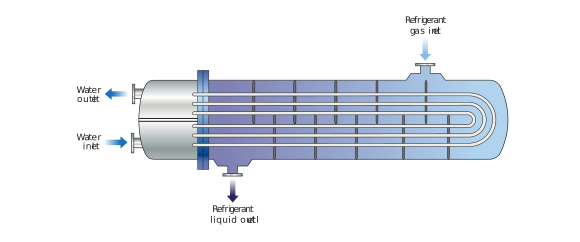
Figure: Water-cooled condenser
For our purposes, we will focus on rejecting heat to the atmosphere.
There are two main types of condensers – wet condensers and dry condensers.
Wet condensers
Wet condensers (or evaporative condensers) use the ability of atmospheric air to evaporate water. This is because the air is not saturated and has the capacity to hold more water. This ability is commonly measured by using the humidity of the air. The higher the humidity, the less capacity it has to hold more water. This is also expressed using a term called the ‘wet bulb temperature’ of air. Wet condensers have lower condensing temperatures than dry condensers because they are governed by the wet bulb temperature and not the dry bulb temperature.
Hot vapour is forced through coils inside the evaporative condenser. Air is then forced over the coils. Water is sprayed over the coils and evaporates from them, removing heat and thus cooling and condensing the primary refrigerant inside. The excess water collects in a sump at the bottom of the condenser, from where it is then recirculated. A typical evaporative condenser operation is shown in the figure below.
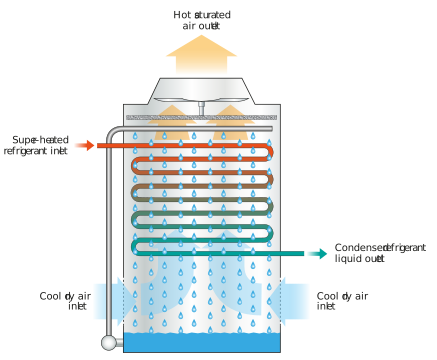
Figure: Wet condenser
As you can see, in this example the air is drawn up from the top. This is called ‘induced draft’. There is also a ‘forced draft’, where the air is forced through from the bottom.
One of the issues with wet condensers is that they use water, which is a scarce and expensive commodity in many places. Some water exits with the air leaving the condenser. Drift eliminators can be used to minimise entrainment. The water circulating in the system becomes contaminated and the dissolved solids increase over time. This means that the water must be treated and periodically replaced. Wet condensers operate under conditions where the bacteria Legionella pneumophilia (which causes Legionnaire’s disease if inhaled) can flourish, so water treatment is of utmost importance.
Wet condensers require more energy to drive the pumps. In order to save energy, the water pumps can be fitted with variable speed drives (VSDs). It is also possible to run a wet condenser dry. This may be an option when weather conditions allow.
Do keep in mind that due to the wet conditions corrosion can be a problem.
Dry condensers
Dry condensers are essentially wet condensers without water! They rely on the ambient temperature of the air to effect the cooling and condense the hot vapour. The figure below shows a typical dry condenser.
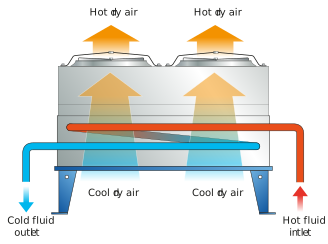
Figure: Typical dry condenser
Dry condensers save water. They also do not need water pumps and water treatment. They are lighter and can be mounted on a roof without requiring extensive civil structures to support them. The capital cost is lower and they are not as susceptible to corrosion. Their only disadvantage is the increased operating temperature, as this impacts the COP of the ammonia plant.
The sizing of the condensers is important as we must ensure that enough condensing capacity is available.