
Lesson 8 - Refrigeration Technology
This lesson takes a closer look at refrigeration technology. It reviews the different primary and secondary refrigerants and explores the technology required to deliver primary refrigeration to the brewery. It concludes by looking at how refrigeration is used within the brewery.
High Pressure Liquid Receiver, Expansion Valve, and Low Pressure Liquid Receiver
The condensed liquid leaving the condenser is at a high temperature and needs to expand in order to drop the pressure and the temperature.
A high pressure liquid receiver collects the liquid refrigerant. This ensures liquid gas separation with a balancing line to the condenser inlet. This also acts as a store for ammonia.
Before the ammonia can be used in the process, it must be at the right temperature. An expansion valve allows the ammonia to expand and the drop in pressure results in a drop in temperature. The figure below shows the components of a typical expansion valve.
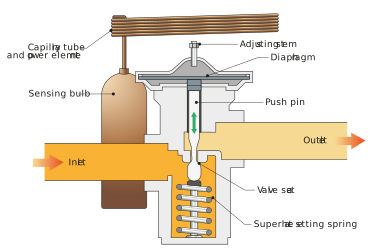
Figure: Expansion valve
The expansion valve allows refrigerant to flow into the low pressure liquid receiver (liquid separator or circulating receiver), which is shown in the figure below as the low pressure receiver. From here, liquid ammonia is pumped to the process and ammonia vapour returns to the vapour space above the liquid. The receivers are shown in the figure below.
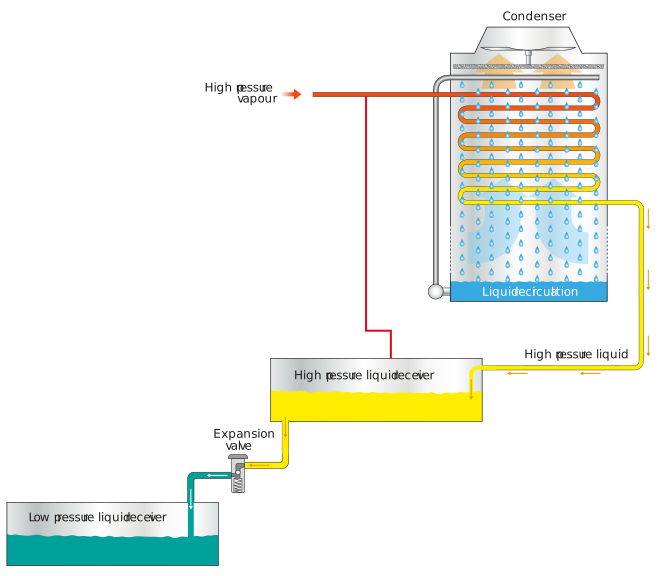
Figure: Schematic of receiver, expansion valve, and liquid separator
This is a very basic illustration of the system. The various different circuits within it make it a lot more complicated in practice.