
Lesson 8 - Refrigeration Technology
This lesson takes a closer look at refrigeration technology. It reviews the different primary and secondary refrigerants and explores the technology required to deliver primary refrigeration to the brewery. It concludes by looking at how refrigeration is used within the brewery.
Reciprocating Compressors
Reciprocating compressors use pistons to compress the gas. The gas is sucked into the cylinder, and is then compressed and finally discharged at a higher pressure.
The figure below shows a typical reciprocating compressor and the basic working of a piston.
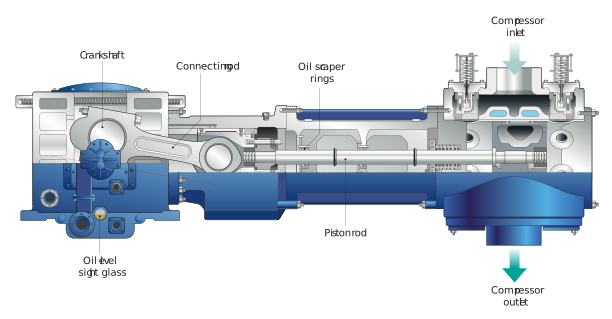
Figure: Reciprocating compressor
Reciprocating compressors typically have a number of cylinders. These cylinders can be ‘stepped’, meaning that one or more can be switched off while the others still continue to operate. Step controllers still only allow for operation at set steps. Some newer reciprocating compressors have been designed for use with variable speed drives. In general, reciprocating compressors are more efficient than screw compressors at part loads. They still require oil to lubricate the pistons.
Advantages of reciprocating compressors include:
-
They have higher efficiencies compared to screw compressors (although this depends on their operation).
-
They have less oil carry-over and thus simpler oil separation.
-
They are more efficient when used for part loads.
-
Their maintenance is simple, and can easily be conducted in-house.
Disadvantages of reciprocating compressors are:
-
They incur high maintenance costs.
-
They are very susceptible to damage if liquid enters them.
-
They have high vibrations, which require civil structures to be capable of handling this.
-
They have large footprints.
-
They have higher gas outlet temperatures (although this could be considered an advantage, as heat energy can easily be recovered).
Let’s have a quick look at oil separation.
Oil separators
When oil is carried over with the compressed gas exiting the compressor, it can be separated out using an oil separator. There are various designs available, but the principle is similar. As hot gas in injected into the separator, oil tends to be forced onto the surface through centrifugal forces. The oil runs down the surfaces and is collected from the bottom. The figure below shows a typical oil separator.
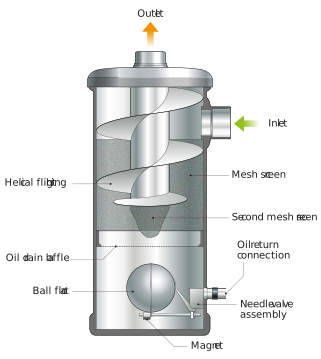
Figure: Oil separator
Now that we have covered compressors, let’s move on to condensers.