
Lesson 8 - Refrigeration Technology
This lesson takes a closer look at refrigeration technology. It reviews the different primary and secondary refrigerants and explores the technology required to deliver primary refrigeration to the brewery. It concludes by looking at how refrigeration is used within the brewery.
Evaporators
Evaporators are heat exchangers between the refrigeration process and the system being cooled. In an air conditioning unit they cool the room air. In modern breweries they usually exchange heat (cooling) between the secondary refrigerant, and the ammonia refrigerant.
The low pressure refrigerant absorbs heat, which vaporises the liquid and turns it into gas.
Evaporators can be flooded or direct expansion evaporators. Direct expansion evaporators are also known as dry evaporators.
Flooded evaporators
The liquid refrigerant covers the entire heat transfer surface in a flooded evaporator. A surge tank is used to control the level, often by means of a float valve. The figure below shows a typical flooded evaporator.
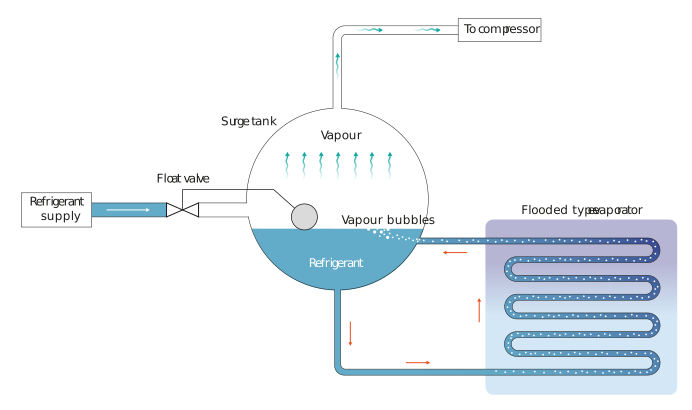
Figure: Flooded evaporator
Flooded evaporators are typically used to cool secondary or tertiary (chill/cooling water) refrigerants. They are very efficient because they utilise the entire heat transfer surface. The heat exchanger holds much more refrigerant than a direct expansion evaporator can. Flooded evaporators provide a large reservoir of cooling and unless this is controlled effectively can cause freezing if the process being cooled does not require it. They are well suited to provide secondary refrigerant cooling as they provide a large reservoir of cooling, so refrigerant temperature is only affected by very large increases in cooling load.
Direct expansion evaporator
These evaporators are designed to fully vaporise the refrigerant. At full design capacity, approximately 20% of the heat exchanger will contain vapour. The figure below shows a direct expansion evaporator.
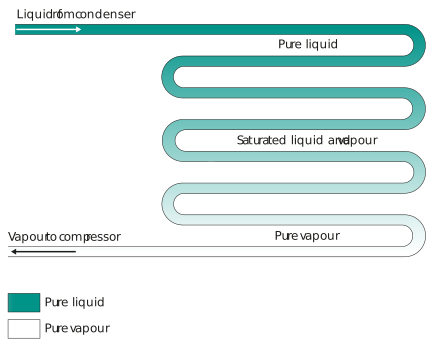
Figure: Direct expansion evaporator
The direct expansion evaporator is controlled by a metering valve (or control valve) that limits the amount of liquid refrigerant entering the evaporator. Plate heat exchangers are commonly used for this as they hold smaller quantities of refrigerant. When ammonia is used in the process, the aim is to minimise the total amount; direct expansion plate heat exchangers can help to achieve this.
Now that we have covered all the parts of the cycle, let’s look at a few of the ways in which they can be put together.