
Lesson 8 - Refrigeration Technology
This lesson takes a closer look at refrigeration technology. It reviews the different primary and secondary refrigerants and explores the technology required to deliver primary refrigeration to the brewery. It concludes by looking at how refrigeration is used within the brewery.
Screw Compressors
Screw compressors come in various forms and designs. The most common type is a twin screw, where one rotor is driven by a motor and the other rotates.
The figure below shows a typical screw compressor.
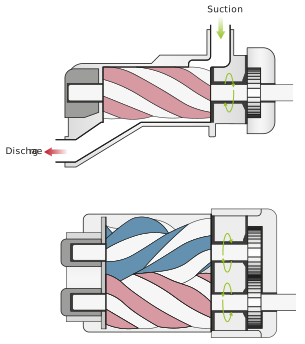
Figure: Typical twin screw compressor
Vapour enters from the suction port and is compressed as the spacing in the rotors become smaller. The compressed vapour exits at the discharge port. This is shown in the figure above.
Compressors are lubricated, which means that oil is injected into the compressor with the gas. The oil lubricates the screws, seals the compression space, and also acts as a coolant. The oil is then recovered from the discharged gas and recirculated.
The following video shows the working of an industrial screw compressor.
Note: this is for illustrative purposes only and is not a recommendation or endorsement of the supplier’s product.
Advantages of screw compressors include:
-
They have a simple structure and fewer moving parts than a reciprocating compressor. They thus generally require less maintenance over longer intervals.
-
They have small footprints.
-
They are suitable for large loads.
-
They can be operated with variable speed drives.
-
Their outlet temperatures are lower than for reciprocating compressors.
-
They have low vibrations.
-
They are resistant to damage caused by liquid entering the compressor.
Disadvantages of screw compressors include the following:
-
They have lower efficiencies compared to reciprocating compressors at temperatures typically found in brewery applications.
-
They are not viable for small loads.
-
They use more energy under partial load than reciprocating compressors.
-
Maintenance is specialised.