
Lesson 2 - Principles of Fluid Mechanics 1
This lesson considers the unique property of viscosity of fluids (gases and liquids) which allows them to flow. It explores the classification of fluid viscosity behaviour by so-called Newtonian and non-Newtonian fluids. It will also examine the nature of static fluids, which will include the concept of pressure and head. The lesson finishes with a discussion on the different types of instrumentation for measuring pressure.
The Bourdon Gauge
Bourdon gauges are probably the most commonly seen gauges in a brewery. They look like a watch, or clock, with a transparent cover and a hand or pointer which sweeps round and indicates the pressure on a scale. But have you ever wondered how they work? How do they translate pressure into the rotational movement of the pointer? Well, we have a watchmaker to thank for their invention!
Bourdon gauges were invented by the Frenchman Eugène Bourdon who was amongst other things, a watchmaker. He invented a means to utilise the pressure of a fluid to change the bend in a sealed tube and translate that deflection into the rotation of a pointer.
The Bourdon pressure gauge (see the figure below) has, at its base, housing suitable for fitting to a source of pressure to be measured, e.g. a pipe or a vessel wall. The pressure to be measured is connected to a curved tube (of elliptical or oval cross-section) inside the housing and connected to a rigid mount. The applied pressure causes the tube to straighten slightly, and the shaft of the assembly carries a needle, which is rotated against a calibrated scale. The scale is graduated to zero when the tube is exposed to purely atmospheric pressure, and so the device measures gauge pressure. It reads the difference in pressure across the Bourdon tube between the fluid and the atmosphere.
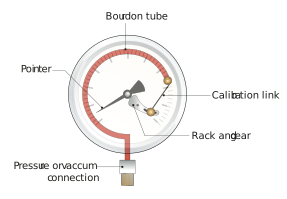
Figure: A Bourdon gauge
Bourdon gauges of this type are more suitable for utility applications as fluid will enter the sensing tube and may leave a residual value. To utilise such gauges in product areas of the brewery, where product cannot be allowed to enter the sensing tube as it cannot be easily cleaned out, a modified version is used. In this case, the sensing tube is filled with a liquid, e.g. silicon oil, and the tube sealed with a diaphragm, such that pressure on the diaphragm is transmitted via the silicon oil onto the sensing tube.