
Lesson 2 - Principles of Fluid Mechanics 1
This lesson considers the unique property of viscosity of fluids (gases and liquids) which allows them to flow. It explores the classification of fluid viscosity behaviour by so-called Newtonian and non-Newtonian fluids. It will also examine the nature of static fluids, which will include the concept of pressure and head. The lesson finishes with a discussion on the different types of instrumentation for measuring pressure.
Differential or U-tube Manometer
This is used to measure the pressure differential between two fluid reservoirs containing fluid with density  R, e.g. different pipes, or parts of the same pipe (we will cover this more in the Fluid Dynamics lesson) or two different vessels or parts of the same vessel.
The pressure gauge is constructed of a U-shaped transparent tube partially filled with high-density liquid of density ρₘ connecting two points at different pressures (see the figure below). The unknown pressure is indicated by the difference between the levels of liquid in the two arms of the U-tube.
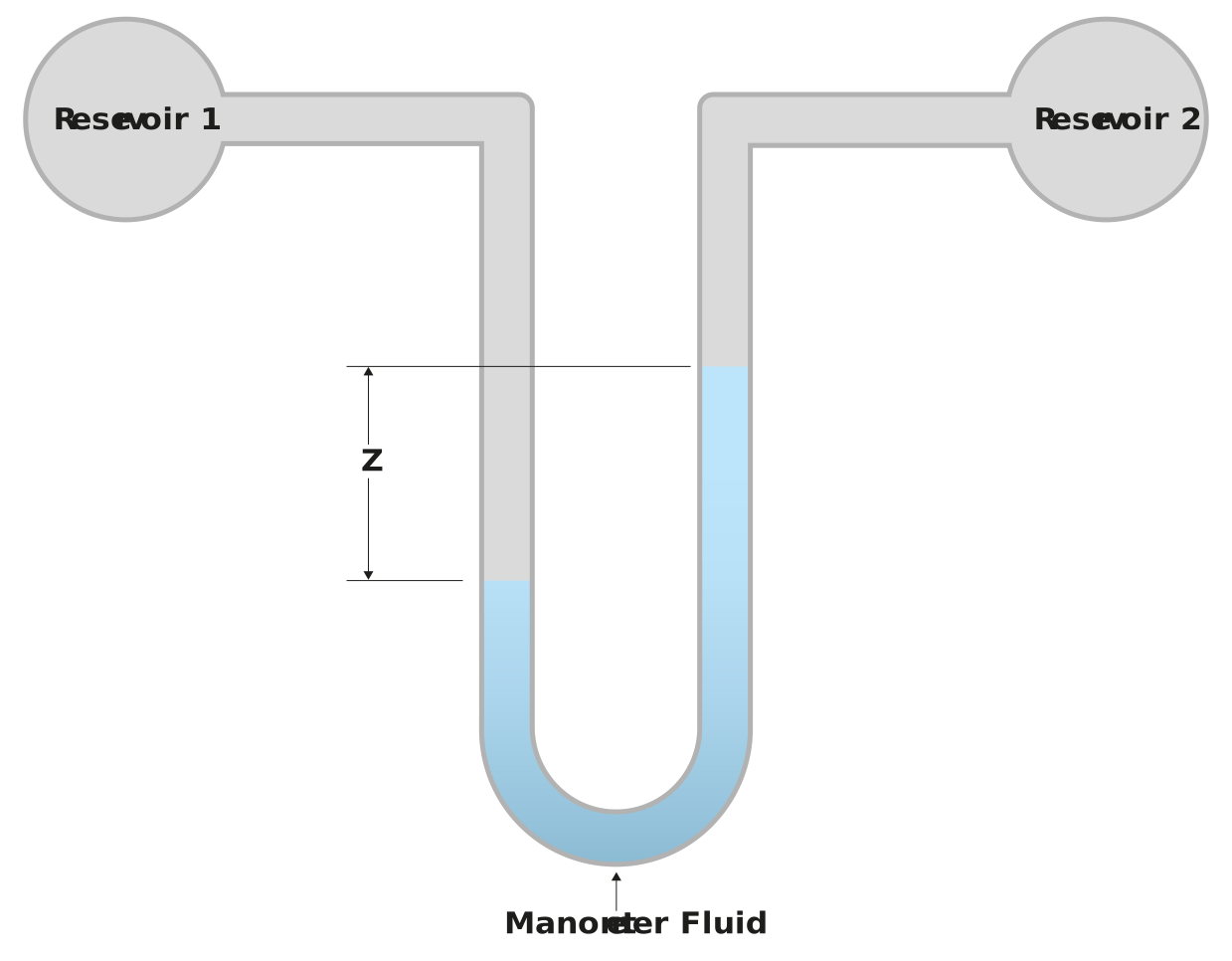
Figure: A U-tube manometer containing fluid of density ρₘ connected between two reservoirs containing fluid of density ρR
The differential pressure is given directly as the head (or vertical interval) of the measuring fluid as:

If the reservoir fluid was a gas, then we could ignore its density term

Example:
A U-tube manometer is used to monitor the pressure across a compressed air filter. The U-tube is filled with liquid of a density 13,600 kg/m³, and the density of the air is 6 kg/m³. If the maximum pressure drop across the filter is to be limited to 0.5 bar, what would the vertical interval be on the U-tube manometer?
Our equation for a U-tube manometer is:

As we are after the vertical interval or distance Z on the manometer, we can rearrange this equation for Z:

And substitute in the values that we know:

If we ignored the density of air from the calculation, the error would be:

With a less than 0.03% difference, we would be more than validated in ignoring the density of air to simplify such a calculation, in this case.