
Lesson 2 - Principles of Fluid Mechanics 1
This lesson considers the unique property of viscosity of fluids (gases and liquids) which allows them to flow. It explores the classification of fluid viscosity behaviour by so-called Newtonian and non-Newtonian fluids. It will also examine the nature of static fluids, which will include the concept of pressure and head. The lesson finishes with a discussion on the different types of instrumentation for measuring pressure.
Vertical Differences of Height
If we consider a vertical column of fluid of height Z where the fluid has a density ρ, then it can be shown that the pressure difference ∆P, between the bottom of the column and the top, is given by:

Where g is the acceleration due to gravity (9.81 m/s²).
Below is a worked example, following on from the previous one and using this concept.
Example:
If we can consider air to have a constant density of 1.2 kg/m³, then what height is a vertical column of air, such that there is a pressure difference of 20 kPa across it?
Writing down the equation which relates pressure difference and vertical difference:
Rearranging for the parameter of interest, namely Z and substituting in values, we have:


Can you see any practical significance of this example, particularly as a follow on from the previous one?
This is an estimate of the elevation of one of the breweries from the previous worked example. It is worth stressing that it is an estimate, as we have assumed that air density does not change with altitude, which we of course know is not the case. Air at altitude is thinner – less dense. A more accurate estimate of the altitude of such a brewery, which has an 80 kPa atmospheric pressure using actual measurements of atmospheric pressure, would be 1,830 m.
We can extend the application of this approach to give us information about the actual pressure, be it absolute or gauge, at any point in a column of fluid, e.g., the pressure at the base of a fermenter due to the column of beer above it and any headspace pressure or the pressure between any two measurement points within a vessel.
Consider the diagram below, which shows a vertical column of fluid, of density ρ, with two measurement points.
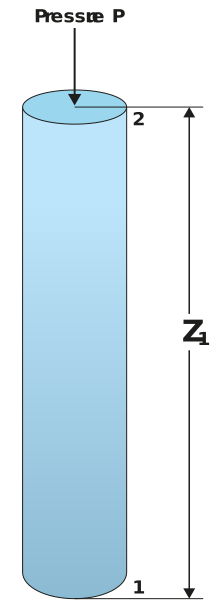
Figure: A column of fluid of density ρ with an external pressure P applied at the top
We can determine the pressure difference between points 1 and 2, ∆P₁₋₂ as:

Next, we should consider the hypothetical influence of the additional pressure P pushing down on the column from an added column of fluid above it, or from gas pressure from the headspace of a vessel. The pressure at point 1 would be given by the sum of P and the pressure difference between 1 and 2, ∆P1-2:

Another way of saying this is that such pressures and pressure differences are additive.
Let us look at a worked example to appreciate this further.
Example:
A cylindroconical fermenter has a wort depth of 15 m (measured from the base of the cone up to the wort surface), and the headspace pressure is 20 kPa (g). If atmospheric pressure is 100 kN/m² and the wort density is 1,060 kg/m³ calculate the absolute pressure at the base of the fermenter cone?
A diagram will help us to understand this example better (see below).
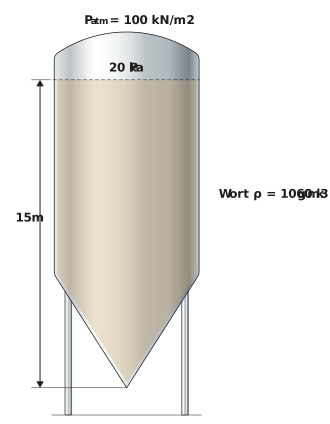
The absolute pressure at the base of the fermenter cone will be given by the sum of:
· Atmospheric pressure of 100 kN/m²
· The headspace pressure of 20 kPa (g)
· The pressure difference due to the 15 m of wort.


