
Lesson 2 - Principles of Fluid Mechanics 1
This lesson considers the unique property of viscosity of fluids (gases and liquids) which allows them to flow. It explores the classification of fluid viscosity behaviour by so-called Newtonian and non-Newtonian fluids. It will also examine the nature of static fluids, which will include the concept of pressure and head. The lesson finishes with a discussion on the different types of instrumentation for measuring pressure.
Viscosity and Newton’s Law of Viscosity
Let us consider an open-ended tube with a reservoir of liquid at the top, as shown in the figure below.
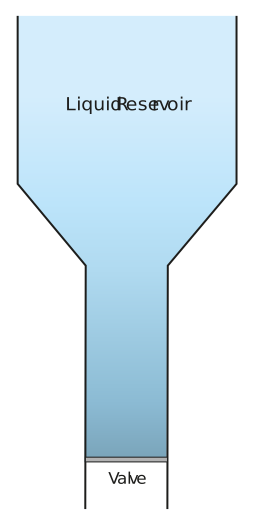
Figure: An open-ended reservoir of fluid
We can see that the liquid is allowed to run freely from the reservoir down the tube. If the liquid flows easily – as water would do – then it would be considered to have a low viscosity. However, if the liquid were a malt extract, crude oil, or treacle, etc., it would slowly run down the tube and as such, would be considered to be highly viscous. Straight away, we can see that our ‘natural’ interpretation of viscosity as the ease by which a fluid can flow, matches with this qualitative description.
This type of equipment (illustrated above) is, in fact, the basis for one of the means of measuring a liquid’s viscosity – termed the Redwood viscometer – where the time is recorded for a set volume of liquid to flow out of the tube. The unit of viscosity, in this case, would be so many Redwood seconds (the number of seconds for the reservoir to empty).
Now that we have a qualitative feel for viscosity – how easily a fluid flows – we can refer to an example first considered by Sir Isaac Newton.
Sir Isaac Newton (1643-1727) is one of the biggest icons of science. We owe much of our understanding of the world (and universe) we live in, to him. His work ranged from mathematics, optics, mechanics of motion, fluid mechanics, and possibly his best-known field, gravity. It is said that he first considered gravity whilst sitting under a tree and being hit on the head by a falling apple.
In the below figure, two layers of liquid, separated by a small distance ∆y, are flowing at different velocities down the tube.
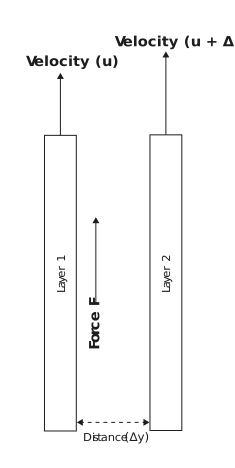
Figure: Two fluid layers separated by distance ∆y
The velocity of the first layer is denoted by the letter u, and that of the second layer is u+∆u. In mathematical notation, (yes, we are heading into the world of mathematics!), ∆u means a difference in velocity u, so by defining layer two’s velocity as u+∆u, we are suggesting that its velocity is different to layer one’s velocity. For the sake of simplicity, we can assume that layer two’s velocity is higher than layer one’s.
All good? As layer two is moving faster than layer one, it will exert a force on layer one, shown in the above diagram as force F. When Newton was not head-butting apples or thinking about gravity, he had another significant thought.
He proposed that the force F exerted by layer two on layer one was related to the velocity gradient between the two layers. To understand this, we perhaps need to remind ourselves what a gradient is.
We are probably more familiar with the gradient of a line on a graph, where the gradient is defined as the slope of the line. Mathematically speaking, the gradient is calculated as the difference in the y values of the line, divided by the difference in the x values. So, we would represent this as:

If the graph was a plot of velocity u against distance y, then the velocity gradient would be the difference in the velocity values, divided by difference in the distance values. We would represent it as:

Now that we have refreshed ourselves on velocity gradients, we can use this information to express Newton’s proposal that the force F between the two layers, across the area between the layers A, is proportional to the velocity gradient between them thus:

As with any proportional relationship such as this, we can turn it into a defined equation by inserting a constant of proportionality (µ) as follows:

The constant of proportionality is termed the dynamic viscosity and has the Greek symbol µ (pronounced mew).
The force F divided by the layer area A is termed a stress (a force per unit area), and as the force is trying to tear or shear the layers apart, the stress is termed a shear stress and is given the Greek symbol  (pronounced tau):

Finally, the small differences in velocity and distance, ∆u and ∆y are reduced to infinitely small differences, du and dy (this is a typical approach from the mathematical field of calculus). The resulting equation is called Newton’s law of viscosity:

The term du/dy is termed the shear rate. One way to interpret shear rate is that it is how much the velocity of a fluid varies from position to position.
If you think of the impact that increasing the speed of a tank agitator would have on the velocities within the fluid being agitated, hopefully, you can see that as the agitator speed increases, the position to position variation in fluid velocities would increase, or in other words, the shear rate would increase.
Therefore, what do you think the impact would be of increasing the agitator speed, and hence shear rate, on the shear forces within the fluid?
The shear forces (or shear stress) would increase – Newton’s law tells us this. This increase of shear stress is the mechanism which allows us to efficiently disperse grist in a mash vessel using agitator speed and also the mechanism which may damage yeast cells if the agitator runs too fast in a yeast storage tank.
It is essential to realise an important implication of Newton’s law of viscosity; in order for dynamic viscosity to be a constant of proportionality, it is not a function of either shear stress or shear rate.
Fluids which conform to this are termed Newtonian fluids, i.e. they conform to Newton’s law of viscosity.
Water and dilute water-based solutions, such as wort and beer, are generally considered Newtonian fluids. We will see in a following section that there is a category of fluids which are important to brewers, but which do not conform to Newton’s law and require special consideration.