
Lesson 2 - Principles of Fluid Mechanics 1
This lesson considers the unique property of viscosity of fluids (gases and liquids) which allows them to flow. It explores the classification of fluid viscosity behaviour by so-called Newtonian and non-Newtonian fluids. It will also examine the nature of static fluids, which will include the concept of pressure and head. The lesson finishes with a discussion on the different types of instrumentation for measuring pressure.
Horizontal Distances – A Special Consideration
So far, we have only dealt with vertical distances, or columns of fluid and their pressures, but what about horizontal distances? The good news is that a simple application of our ∆P = ρgZ equation tells us a very important thing about pressure and horizontal distances for static fluids. We will look at this now.
Imagine a horizontal pipe full of a static fluid of density ρ, with two points of interest, 1 and 2, which are on the same horizontal level, such that the vertical distance Z1-2 between them is zero.
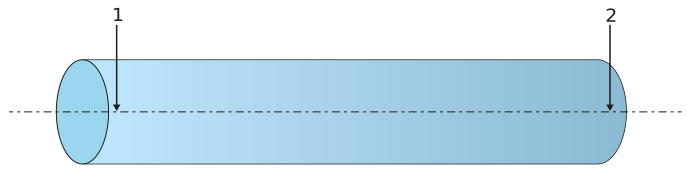
Figure: A horizontal pipe full of static fluid of density 
We can apply our equation to determine what the pressure difference between points 1 and 2 might be:


We can easily see that if two points are on the same horizontal plane, and hence have no vertical distance between them, then there is no pressure difference between them, i.e. they have the same pressure. This is as appropriate within the pipeline situation shown, or for static fluid within a tank or in the atmosphere.
We have considered pressure in quite some detail and how to estimate, calculate, and manipulate pressures. Now would be a good time to look at how pressure can be measured within a brewery or a maltings.