
Lesson 2 - Principles of Fluid Mechanics 1
This lesson considers the unique property of viscosity of fluids (gases and liquids) which allows them to flow. It explores the classification of fluid viscosity behaviour by so-called Newtonian and non-Newtonian fluids. It will also examine the nature of static fluids, which will include the concept of pressure and head. The lesson finishes with a discussion on the different types of instrumentation for measuring pressure.
Pressure Measurement
Pressure measurement can be important for a variety of reasons.
These include:
-
The pressure itself is of interest, e.g. ensuring that a tank does not exceed design pressure which would cause a mechanical failure of the tank.
-
The pressure value is an indicator of another factor, e.g. pressure difference across an orifice plate can be used to indicate fluid flow rate or the pressure in a pressurised gas cylinder can indicate how full or empty the cylinder is.
Many different types of pressure measurement instrumentation are available, and we will now explore some of these types.
Piezometer tube
A piezometer (piezo is Greek for press, so literally a press[ure] meter) is the simplest example of a pressure gauge. It is simply an open-ended vertical tube connected to a pipe, or vessel containing liquid under pressure and is shown in the figure below. With the pipe or vessel under pressure, the liquid rises up the tube until the pressure of the column of liquid balances the pipeline pressure.
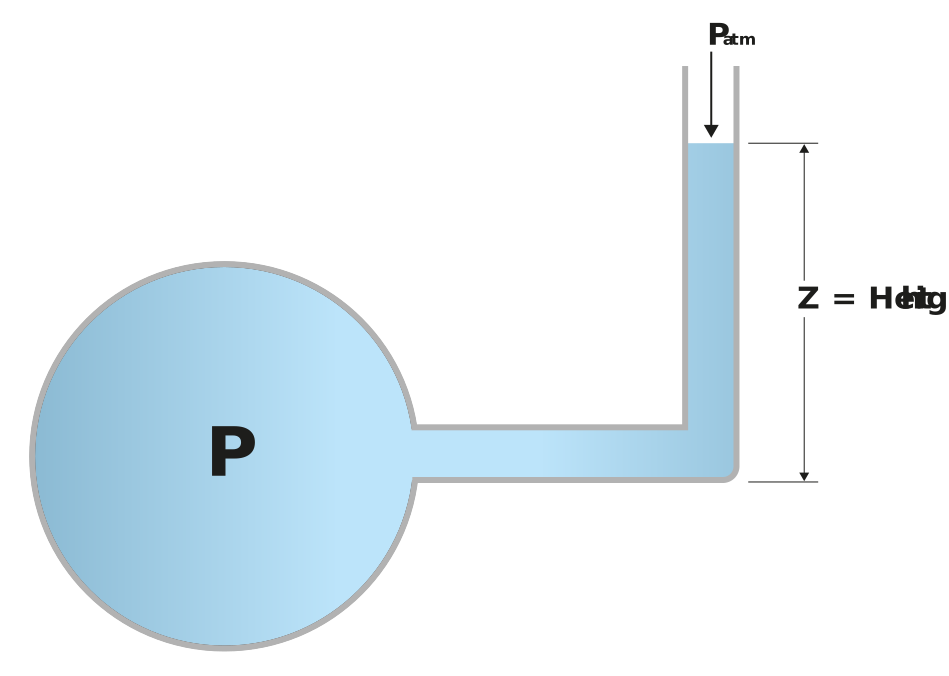
Figure: A piezometer connected to a pipe at pressure P
The pressure difference due to the column of liquid of height Z within the piezometer is given by:

The pressure within the pipeline pushing upwards on the column of liquid within the piezometer is P, and the pressure pushing downwards on the column is atmospheric pressure Patm. Hence, the pressure P is equal to the sum of P atm and ΔP:

Substituting the expression for ∆P into this equation gives:

Is P, as shown in the equation, an absolute or a gauge pressure?
It is an absolute pressure as it is a pressure accounting for atmospheric pressure. If we wanted to know the value of P as a gauge pressure, we would deduct atmospheric pressure thus:

Hence, the pipe or vessel gauge pressure can be determined from the height Z alone.
The piezometer has limited application in the hygiene- or oxygen-sensitive areas of the brewery. The product within the pipe or vessel would be in contact with the atmosphere at the top of the column. Such a narrow and long tube would also be difficult to clean. Such instruments tend to be confined to the utility area for water applications.