
Lesson 2 - Principles of Fluid Mechanics 1
This lesson considers the unique property of viscosity of fluids (gases and liquids) which allows them to flow. It explores the classification of fluid viscosity behaviour by so-called Newtonian and non-Newtonian fluids. It will also examine the nature of static fluids, which will include the concept of pressure and head. The lesson finishes with a discussion on the different types of instrumentation for measuring pressure.
Non-Newtonian Fluids
Non-Newtonian fluids, as their name suggests, do not conform to Newton’s law of viscosity. Specifically, their viscosity is a function of shear rate du/dy. So, if the shear rate varies within a tank or a pipeline, for example, then the viscosity of these fluids varies as well. This has the effect that the same fluid will behave as a thicker or thinner fluid at different places in the tank, or pipeline.
This difference in viscosity behaviour can result in the following processing issues:
-
Difficulty in circulating the contents of agitated tanks
-
Preferential flow from tanks undergoing emptying, i.e. the tank does not empty evenly.
Do not get confused with viscosity being a function of temperature here. Most fluids get less viscous as their temperature is increased; however, we are considering only the shear rate and viscosity effects.
By far the most common type of brewing fluid, which can generally be considered non-Newtonian, are yeast slurries. An example of yeast slurry non-Newtonian behaviour can be seen in the figure below, which shows viscosity (here termed apparent viscosity) reducing substantially by well over one hundred times with increasing shear rate (not surprisingly this behaviour is called shear-thinning).
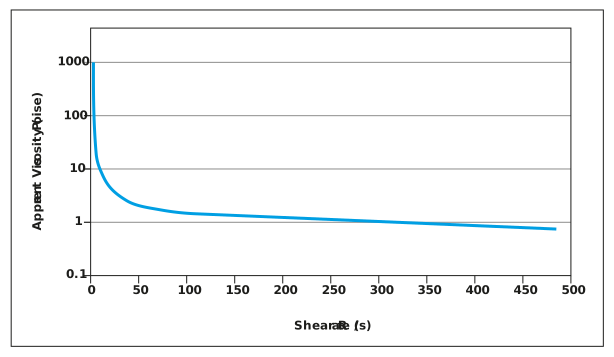
Figure: Variation in apparent viscosity with shear rate for a production lager yeast slurry of 50% (spun wet solids)
We have seen that yeast slurries can have significantly different viscosities depending on the shear rate that they are exposed to. This leads us to question which value of viscosity we might use to determine the shear stress within the slurry for a given shear rate? The answer is that we need to include viscosity in Newton’s law, not as a constant as we have done so far, but as a function of shear rate. This makes the mathematics very involved. The good news is that the approach is not only beyond the scope of this lesson, but in all likelihood would be beyond what we would face in our brewing careers. However, we must be aware of the danger of selecting a single viscosity value for a non-Newtonian fluid and seek experienced help in practical situations.
A single viscosity value cannot be used with any confidence for a non-Newtonian fluid. It is best to seek specialist help when dealing with the mechanics of such fluids.