
Lesson 4 - Health and Safety
In this lesson we will discuss key health and safety issues within breweries. It will enable you to understand the primary legislation and how it impacts on management standards, along with occupational hazards and risks.
Near Miss and Accident Investigation
Despite our best efforts, things may still go wrong from time-to-time. If the injury is severe, there will be a legal obligation to report this, and an appointed authority of some sort may independently investigate it.
Most companies will also keep a record of all accidents, with varying levels of reporting. Accident and incident investigation can be reactive or active.
Reactive systems
Reactive systems, by definition, are triggered after an event and include identifying and reporting:
-
Injuries and cases of ill health (including monitoring of sickness absence records)
-
Other losses, such as damage to property
-
Incidents, including those with the potential to cause injury, ill health or loss
-
Hazards
-
Weakness or omissions in performance standards.
Near miss and accident investigation is the process of gathering information regarding the causes of an incident, with the purpose to formulate control measures and prevent the incident from reoccurring. The usual steps include to:
-
Establish what happened
-
Identify the reasons for substandard performance
-
Identify the underlying failures in the health and safety management system
-
Learn from events
-
Prevent recurrences
-
Satisfy legal and reporting requirements
Manufacturing techniques for problem solving such as ‘5-Why’ are useful near miss and accident investigating tools.
Have a look at the link below for further information on 5-Why.
https://en.wikipedia.org/wiki/Five_whys
It is widely reported that the frequency of accidents decreases with their severity. Thankfully, there are far fewer fatalities than there are first aid cases, as shown in the well-known safety triangle below.
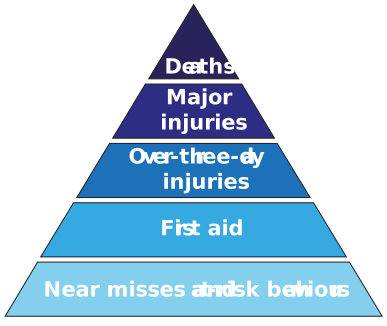
Figure: The safety triangle
This would suggest that we can learn a lot by investigating near misses (or no-injury incidents).
Near misses are events that have not resulted in significant harm but have the potential to cause an accident, injury or damage under different circumstances.
Active systems
Active systems are proactive, and monitor the design, development, installation, and operation of management arrangements, risk assessments and workplace precautions.
Active monitoring gives the organisation feedback on its performance before an accident, incident or ill health. It includes monitoring the achievement of specific plans and objectives, the operation of the health and safety management system, and compliance with performance standards. This provides a firm basis for decisions about improvements in risk control and the health and safety management system. Furthermore, active monitoring measures success and reinforces positive achievement by rewarding good work, rather than penalising failure after the event. Such reinforcement can increase motivation to achieve continuous improvement.