
Lesson 4 - Health and Safety
In this lesson we will discuss key health and safety issues within breweries. It will enable you to understand the primary legislation and how it impacts on management standards, along with occupational hazards and risks.
Key Risks
The next section will describe some key risks within a brewery, including fire, dust and dust explosions, chemicals, and gases.
Fire
Breweries, although making a liquid and essentially non-combustible product, are not immune from fire. Many breweries will have fire protection systems in place, such as automatic sprinklers and firewalls. While such systems will assist in protecting people from fire, they are often aimed primarily at asset protection.
It is vital (and obligatory in most countries) that a detailed fire risk assessment is carried out to reduce the risks of fires occurring, and to ensure the safe evacuation of everyone.
Dust and dust explosion
Dust and fine powders can be dangerous to health if breathed in and can create a potentially explosive atmosphere in the air.
Firstly, let us look at the term Workplace Exposure Limits, (WELs). These are intended to help prevent excessive exposure to a specified hazardous substance by controlling exposure below a set limit. A WEL is the maximum concentration of an airborne substance averaged over a reference period, to which employees may be exposed by inhalation. Two time periods are used: long term (8 hours); and short term (15 minutes). Grain dust is typically assigned a WEL of 10 mg/m3, 8-hour time-weighted average (TWA). Over any 15-minute period, the exposure should not normally exceed 30 mg/m3.
To learn more about the risks associated with grain dust, see the HSE Grain dust Guidance Note EH66 (Third edition).
http://www.hse.gov.uk/pubns/eh66.pdf
With regards to explosivity, most organic dust is combustible. For the brewing industry, this includes dust from ingredients such as malt, barley, sugar, maize, rice, cassava, sorghum, and dried yeast.
A dust explosion can occur if the finely divided powder (typically below 500 μm particle size) is dispersed into the atmosphere in the presence of an ignition source. When ignition occurs, flames propagate through the dust cloud. Such flame propagation in an enclosure will result in the generation of pressure and may produce explosions when this pressure is released into the atmosphere: either because of accidental bursting of the enclosure or by the venting through intentional relief. In many respects, dust explosions are similar to gas explosions inside buildings.
You may be familiar with the brewing term propagate, with regards to yeast. However, the definition of propagate in physics is ‘to send out or spread light or sound waves, movement, etc., or to be sent out or spread’. During a dust explosion, it refers to the spread of the flame front.
Only when dust is mixed with air in the correct proportions will flame propagation be supported. The lower flammable limit (LFL) of grain dust in air is 50 g/m3 and dust concentrations in air below this limit will not support explosion flame propagation. This represents a high concentration in terms of appearance, and a cloud density would be clearly visible. Such high concentrations of dust are not likely to be present in the open spaces within buildings but may exist in equipment enclosures.
The graphic below shows that, just like fire, combustible dust (fuel) requires oxygen and an ignition source to burn. However, for an explosion to occur, the fuel needs to be made up of fine particles (powder), and these need to be distributed in a concentrated cloud in the air. This is enough for a flash fire in the open to occur. For there to be an actual explosion, some form of confinement is required – normally by a vessel or building. This is called a primary explosion.
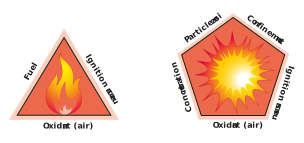
Figure: The fire triangle and dust explosion pentagon
Any primary explosion resulting from the ignition of dust in such an enclosure may propagate into either a building or part of an adjacent plant. It can occur even when the secondary compartment does not initially contain airborne dust. This process is usually referred to as the secondary dust explosion hazard. There are a few types of secondary explosion, but for now we will limit our discussion to type one. Buildings that enclose dust handling plants tend to become dusty and the accumulation of dust on horizontal surfaces may present a secondary explosion hazard. In the past, secondary combustions in buildings have been responsible for the most serious explosions. A primary explosion can produce flame and mild shock waves which result in the rousing of dust from surfaces. The flame propagation through this freshly roused dust results in the pressurisation and ultimate destruction of the buildings. Such explosions are referred to as secondary explosions – type one (i.e. secondary due to dust contamination on surfaces).
Primary dust explosions typically occur inside process equipment, but these explosions can rouse dust in the general workplace, possibly causing massive secondary explosions.
To reduce the risk of a dust explosion, it is important to ensure good housekeeping, and that dust is not allowed to collect outside of process equipment. Powder layers on ledges, equipment surfaces etc. should be limited in extent and thickness. A powder layer of 1 mm thick uniformly distributed throughout the workplace can generate a flammable atmosphere up to five metres high.
Dust explosion safety is a specialist subject. A suitable basis of safety for process operations involving combustible dust must be defined.
The basis of safety is defined as the fundamental safety philosophy which ensures an item of equipment can be operated, or an operation performed, in a safe manner with risks that are as low as reasonably practicable. For equipment or operations handling combustible dust, safety can be based on either explosion prevention or explosion protection.
Explosion prevention offers the advantage that no account needs to be taken of the potential consequences and avoids the need for protective measures. Explosion prevention can be implemented through the following strategies:
-
Avoidance of explosive atmospheres (e.g. inerting)
-
Elimination of ignition sources (e.g. hotwork control)
Explosion protection, on the other hand, accepts that, despite measures being taken to prevent an explosion, the explosion risk warrants further measures to mitigate the consequences if an explosion should occur. The following strategies can implement explosion protection:
-
Explosion containment (i.e. design for maximum explosion pressure)
-
Explosion suppression (i.e. install extinguishing system)
-
Explosion venting (i.e. provide weak panels to relieve pressure)
-
Explosion isolation (i.e. prevent explosion propagation)
Where protective measures are used as a basis of safety, efforts must still be made to avoid explosive atmospheres and eliminate ignition sources. This will minimise the frequency of demands on protective measures. The consequences of mitigated explosions will still cause process interruption and possible damage to equipment, which are undesirable.
Areas of concern in a brewery are the grain elevators feeding both the silos and the dry milling of malt. Both are likely to contain explosive atmospheres during normal operation, and the control of potential ignition sources is important. Isolation devices (typically a rotary valve or specially designed screw conveyor) between the intake grain elevator discharge and the silos are one of the most important safety devices in a brewery. They will prevent an explosion in the grain elevators from propagating into the silos and causing a massive secondary explosion. Correctly sized and rated explosion panels on vessels receiving dry powder (silos, cyclones and grist cases) is also typically necessary.
In the European Union there are two important directives for controlling explosive atmospheres, commonly referred to as the ATEX directives. These are available on the European Commission’s website:
https://ec.europa.eu/growth/sectors/mechanical-engineering/atex_en
All European member states, and many other countries globally, have adopted this or very similar legislation.