
Lesson 4 - Health and Safety
In this lesson we will discuss key health and safety issues within breweries. It will enable you to understand the primary legislation and how it impacts on management standards, along with occupational hazards and risks.
Health and Safety in the Organisation
Within an organisation, health and safety can be regarded as an important business process. H&S management should be an integral part of overall brewery management rather than a stand-alone system managed by someone not directly involved in every day operations. The Management Process section below offers guidance on how to regulate health and safety in the workplace.
Management process models, discussed in more detail below, can be defined as ‘a thing used as an example to follow or imitate’. In the next few sections, we will consider various models for management, hazard identification, risk assessment, and accident investigation. These models or examples are not absolute rules on how something should be done. If your organisation proposes or uses a different kind of model, it does not mean it is the wrong one. Each organisation adopts a model which fits their needs and working practices.
Management process (Plan, Do, Check, Act)
Probably the best known and most widely adopted model for H&S management is the ‘Plan-Do-Check-Act’ cycle. The origin of this is attributed to the famous management consultant William Deming.
The process, as it applies to H&S, is best described by the graphic below:
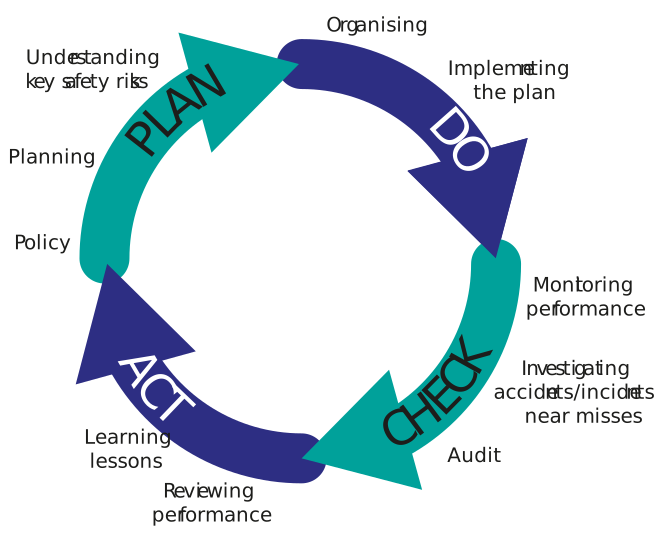
Figure: The “Plan, Do, Check, Act” management model as applied to H&S
Here are the steps in more detail:
Plan – Determine the policy and plan for implementation
-
In many regions, having an H&S policy is a legal requirement. It is a statement of a company’s strategy, consisting of their objectives to achieve a safe working environment, their responsibilities, and the arrangements for implementing the strategy and attaining their aims.
-
The policy needs to be backed up with a plan on how the objectives of the policy will be measured and achieved.
Do – Organise for health and safety and implement the plan
-
Undertake a risk assessment to identify what could cause harm in the workplace, who it could harm and how, and what can be done to manage the risk.
-
Decide on what the priorities are and identify the biggest risks.
-
Organise activities to deliver the plan, including involving co-workers and employees.
-
Set a budget and the allocation of resources.
-
Implement the plan by deciding on preventative and protective measures required and provide the correct equipment and tools for all jobs.
-
Develop training so that everyone has the appropriate level of competence.
Check – Measure performance (monitor before events, investigate after events)
-
Facilitate the correct level of supervision to ensure plans are being implemented correctly.
-
Assess how well risks are being controlled and how well the plan is being implemented.
-
Periodically audit the plan and controls.
Act – Review performance, act on lessons learnt
-
Learn from the audit gap analysis, as well as from incidents and accidents.
-
Review and improve the plans.
-
Revert to the Policy and check it is still appropriate and relevant.
For further information, see the Health and Safety Executive booklet, “Managing for health and safety”, Third edition 2013, available online for free from the HSE website.
H&S management standards
You may already be familiar with the international standards on quality management system ISO 9001. You may also be aware of the environmental management system, ISO 14001.
Previously the safety equivalent, 18001, was only published as a British Standard BS OSHAS 18001 for occupation health and safety management systems, but there was not an ISO version of this. However, this has now been replaced by ISO 45001, ‘Occupational health and safety management systems – Requirements’. It was developed by the International Organization for Standardization’s (ISO) occupational health and safety experts and follows other generic management system approaches such as ISO 14001 and ISO 9001. It is intended to help organisations by providing a framework to improve employee safety, reduce workplace risks and create better, safer working conditions, all over the world.
As of 2019, ISO 45001 was adopted as a national standard by 49 countries which includes the United Kingdom, United States, South Africa, and Australia.
Managing contractors
A particular area of health and safety management concern is that of contractor management.
A contractor is anyone who performs work for the company but is not an employee. Using contractors – for maintenance, repairs, installation, construction, demolition, and many other jobs – may be routine for many companies. Unfortunately, many accidents involve contractors working on-site.
Most companies will have a procedure for the managing of contractors, which is often linked with the procurement of contractors and their selection. It will usually include such things as checking insurances, compliance to policies, validation of appropriate training, and competency of workers.
During the planning of the job, a risk assessment of the work must be carried out. This should be discussed with the contractor, who is likely to do the work. Before arriving on-site, the contractor must provide a detailed safety method statement.
A method statement must include how the contractor intends to do the work safely and must reference the key hazards identified in the completed risk assessment. It must also include any Personal Protective Equipment (PPE) they will wear (to comply with site rules, as well as control measures identified during the risk assessment).
Induction training should be provided by the brewery, tailored to the type of work the contractor will be doing. Contractors may not be familiar with the site’s (or company’s) specific safety systems such as the lockout procedure or permit to work systems. All breweries, regardless of size, should have lockout and hotwork control (or permit) systems in place. If the company has a pipe colouring scheme, it is vitally important to make sure contractors are aware of the detail so they can identify the kind of pipe they are planning to work on. Mistaking an ammonia pipe for a sprinkler pipe could have catastrophic consequences.