
Lesson 2 - Environmental Sustainability
In this lesson we will discuss key ways to understand and improve the sustainability of brewery operations. This will include understanding the global context for sustainability, the key environmental sustainability impacts of producing beer and opportunities for improving the sustainability of beer and brewing operations.
Feedstocks, Processes, and Products
Brewery co-products have great potential for new applications and technologies, adding value both in terms of potential revenue for the brewery and in environmental benefit.
The figure below shows potential flows from brewery co-product feedstocks and processes that are used to create both novel and well-established products.
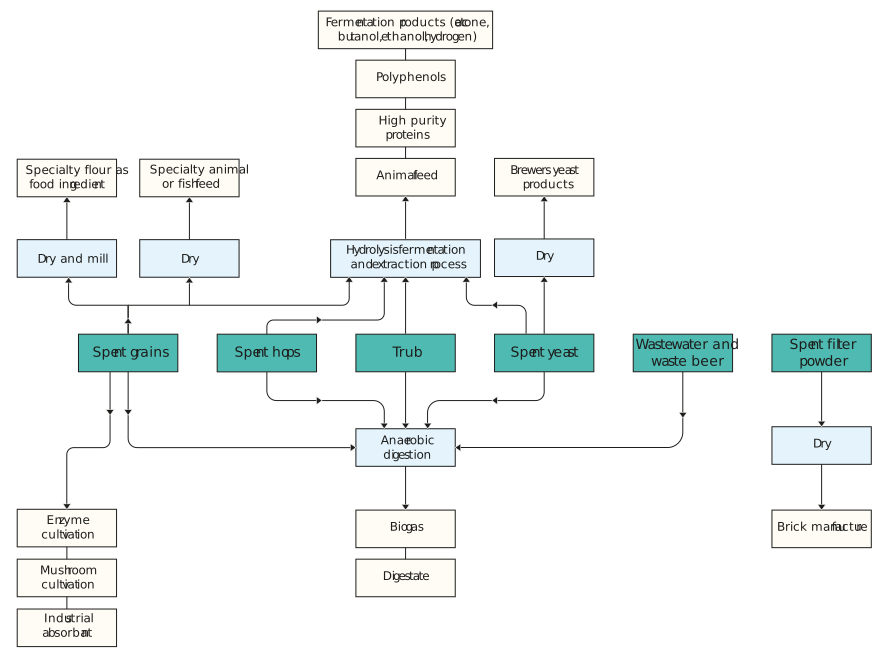
Figure: Brewing co-products feedstocks, processes, and products
Spent grains
As we have previously learnt, brewers are already innovating with spent grains and are using them to create packaging products. They are also examples of spent grains being used to create other products like single-use plates and speciality paper products.
Rather than feeding to farm animals to create food for humans, spent grains can also be used in direct production of food products on a small scale. This is typically employed from smaller brewing operations, allowing a local food focus and novel flavour characteristics. Examples include using spent grains as an ingredient in high-fibre breads, cookies and biscuits, sausages, and even treats for dogs!
http://realhomebrew.com/2012/03/19/top-ten-uses-for-spent-grain-from-your-homebrew/. Note, this is for illustrative purposes only and is not a recommendation or endorsement of the supplier's product.
https://www.regrained.com/blogs/upcyclist/the-other-sustainable-uses-of-spent-grain. Note, this is for illustrative purposes only and is not a recommendation or endorsement of the supplier's product.
In some circumstances spent grains can be used to generate energy. This can be through:
-
Drying and combustion to generate electricity and/or heat
-
Production of biogas (methane) via anaerobic digestion
These options may be carried out on the brewery site itself or elsewhere via a third party. Using spent grains for energy production may contribute to increasing environmental sustainability of the brewing operations. Energy from spent grains is considered a low carbon option because the carbon emissions from the barley growing are attributed to the primary use of the barley.
Novel and future applications
There are also many opportunities to utilise brewing co-products as feedstocks for producing higher-value chemicals. Various techniques including hydrolysis, fermentation, ultrafiltration, and alkali fractionation have been demonstrated to produce different chemicals that can be used in manufacturing, and several nutraceuticals that can be used in dietary supplements for human and animal nutrition.
These include:
-
Extracting polyphenols for use in cosmetics
-
Tannin extraction for leather processing
-
Extracting cellulose which can be used as a feedstock for other chemical processes
-
Extracting protein, which can be used as a food ingredient
https://www.newfoodmagazine.com/article/269/future-applications-for-brewers-spent-grain/. Note, this is for illustrative purposes only and is not a recommendation or endorsement of the supplier's product.
This is an exciting area for brewers to collaborate with other organisations for a more sustainable brewing industry of the future.