
Lesson 2 - Environmental Sustainability
In this lesson we will discuss key ways to understand and improve the sustainability of brewery operations. This will include understanding the global context for sustainability, the key environmental sustainability impacts of producing beer and opportunities for improving the sustainability of beer and brewing operations.
Climate Action
Climate change is a huge global issue. Before we dive into what we need to do about it, we consider what climate change is and why we need to care as brewers.
The earth’s climate is maintained by a layer of gases in the upper atmosphere, such as carbon dioxide, and are called Green House Gases (GHGs). Solar radiation from the sun travels through these gases to the earth’s surface where it is absorbed and warms the planet. This energy is then emitted back out as infrared radiation. Some of this radiation is trapped by the GHGs in the atmosphere, creating what is called the greenhouse effect. Without this effect, the earth would be extremely cold and uninhabitable.
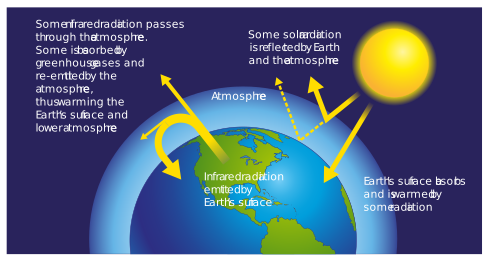
Figure: The greenhouse effect helps to maintain Earth’s temperature
Human activities such as burning fossil fuels (e.g. coal, oil and gas) and land use change, (e.g. deforestation and conversion of land for agricultural use) have contributed to huge additional quantities of GHGs being released into the atmosphere. These additional gases have meant that more heat is trapped within the atmosphere, which is changing the climate we experience on earth.
What is the difference between climate and weather? Weather reflects short-term conditions of the atmosphere while climate is the average daily weather for an extended period at a certain location.
Green House Gases
GHGs are not limited to carbon dioxide; many other gases contribute to global warming. Each of these gases has a different ‘global warming potential’ (GWP) in the atmosphere, which is expressed as carbon dioxide equivalents or CO2e. The GWP of a molecule of the gas is compared with one molecule of carbon dioxide. Some of the more commonly emitted GHGs are shown in the table below. These include sulphur hexafluorides (HFCs) and perfluorocarbons (PFCs) which are used as refrigerants, although this is only a small number of all the GHGs. The vast differences in GWP means that the volume of emissions, as well as the impact of each gas, is important to consider.
Table: Global warming potential of commonly emitted GHGs
|
Name |
Chemical Symbol |
Global Warming Potential (CO2e) |
|
Carbon Dioxide |
CO2 |
1 |
|
Methane |
CH4 |
28 |
|
Sulphur Hexafluoride |
SF6 |
23,500 |
|
Nitrous Oxide |
N2O |
265 |
|
Hydrofluorocarbons |
HFCs |
4 - 12,400 |
|
Perfluorocarbons |
PFCs |
6630 - 11,100 |