
Lesson 2 - Environmental Sustainability
In this lesson we will discuss key ways to understand and improve the sustainability of brewery operations. This will include understanding the global context for sustainability, the key environmental sustainability impacts of producing beer and opportunities for improving the sustainability of beer and brewing operations.
Water Management Systems
Taking a systematic approach to water management is an important way to understand brewery water use and to find ways to reduce this use. Similar management system techniques to those discussed in the Energy and Carbon Management section can be deployed.
In the energy and carbon management system we discussed the areas of:
-
Boundary
-
Baseline
-
Metering
-
KPIs
-
Benchmarking
-
Goals and targets
-
Improvement projects
Next, we discuss some additional information within this framework and the differences specific to water use. Note that waste water management is not included in this section as it is part of the Utilities lesson in this unit.
Boundary
The same types of information, as discussed in Energy and Carbon Management section, can be used to define the boundary of the water management system. However, as we have learnt, the local watershed context is important to understand as well. Looking beyond the brewery, and incorporating information on the context the brewery is operating in, can help us to make better decisions on how to manage brewery water use in a responsible way.
Baseline
In addition to the areas we discussed in the Energy and Carbon Management section, a useful technique to apply in creating the baseline and analysing the brewery system for savings opportunities is to produce a mass balance – of water going in and out of the site, and where it goes in between. This data can be illustrated in a Sankey diagram (shown below).
This information can even be taken one step further. For each individual production process, a water usage diagram can be created and analysed. For example, water usage at each step of a CIP sequence can be assessed and opportunities for reduction identified.
Sankey Diagram – a Sankey diagram is a flow diagram where the arrows are in proportion to the quantity of the flow they are representing. They are often used to visualise material transfers between processes, particularly water and energy.
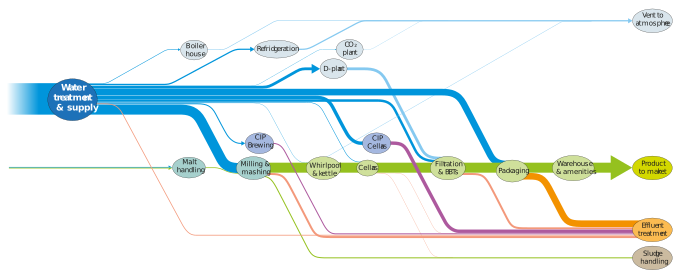
Figure: Example of a diagram showing flows of water through the brewery
Metering
As with energy, metering water use at site level and then at process and equipment level can give the data needed to understand trends and control consumption.
The method of gathering data and the frequency of meter readings may vary. As discussed with energy, meters are available that transmit their reading automatically on a half-hourly basis. These are used increasingly for automatic, cloud-based management systems that support short interval control. It can also sometimes be appropriate to use temporary meters to enable critical monitoring points to be identified.
Key Performance Indicators
Again, just like with energy, defining and tracking the right KPIs can help ensure that water users in the brewery have the right information to understand what is going on in the system and make informed decisions.
Common KPIs for water management are listed in the table below:
Table: KPIs that can be used in water use management
|
Name |
Description |
KPI |
|
Water use |
Total water is use in a given period |
hL / time |
|
Water use by source |
How much water is used from each source drawn upon in a given period, this may include: - Municipal - Well - Surface (e.g. river, lake)
|
hL of source / time |
|
Water use efficiency |
Ratio of useful work delivered to water used to accomplish a certain task |
hL water / hL production |
|
Total water cost |
Total spend on water in a given period |
$ |
|
Water cost efficiency |
Water costs per unit of production |
$/hL |
Benchmarking
Alongside the considerations already noted on benchmarking, it can be useful to consider benchmarking against sites in a similar water environment. If for example, you are operating a brewery in a water scarce area, then talking to other breweries in similar water scarce areas may be more comparable than benchmarking with a site that has few constraints on how much water they can use.
Goals and targets
Generating longer-term goals for water that respond to any challenges that have been found in the watershed your brewery is operating in is an important step. For example, if you have found your site is in an area of water scarcity, this may indicate the need to reduce overall water use to a greater extent than in an area of water abundance.
As water is an essential ingredient, incorporating water into decision making on investment into new plant and brewery expansions is important and not just for environmental sustainability reasons.