
Lesson 2 - Environmental Sustainability
In this lesson we will discuss key ways to understand and improve the sustainability of brewery operations. This will include understanding the global context for sustainability, the key environmental sustainability impacts of producing beer and opportunities for improving the sustainability of beer and brewing operations.
Water Management
We know that water is essential to life: think how many times you have used water today already, and of course, it is one of the main ingredients in beer! However, there are significant challenges in some regions of the world, and climate change is creating new water challenges. Therefore, it is critical that we act as good water stewards by understanding the context and challenges of the watersheds we operate in, being efficient in the water we use and managing waste water through correct and responsible treatment.
As one of the main raw materials in beer, access to a sustainable water supply is critical to the brewery. We need:
-
Product water for producing the beer itself
-
Process water for cleaning the brewery plant, washing beer packaging before filling, cooling, and heating
-
Service Water for using in boilers, utility cooling towers and general cleaning water
It could, perhaps a little cynically, be said that aside from the product water, breweries borrow water from the environment and:
-
Treat it as needed
-
Use it once (mostly)
-
Treat it again
-
Dispose of it
This can be represented as the ‘Water Supply Chain’.
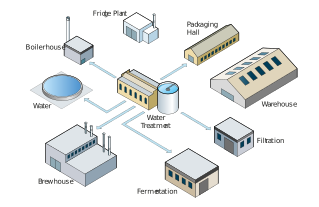
Figure: Typical brewery water supply chain from and to the environment
The following are typical sources of water into the brewery:
-
Municipal water supply
-
Ground water (e.g. boreholes)
-
Surface water (e.g. rivers, lakes)
Once used, waste water may return to the environment via various options:
-
Expelled straight out into the environment with minimal or even no treatment
-
Brewery-owned waste water treatment plant (WWTP)
-
Municipal WWTP
As indicated above, this water supply chain is an interaction with the environment. In the case of water this is best understood by looking at the watershed we are situated in.