
Lesson 2 - Environmental Sustainability
In this lesson we will discuss key ways to understand and improve the sustainability of brewery operations. This will include understanding the global context for sustainability, the key environmental sustainability impacts of producing beer and opportunities for improving the sustainability of beer and brewing operations.
Energy and Carbon Improvement Projects
Even with an excellent management system in place with KPIs tracked and reviewed regularly, and goals recorded that we would like to achieve, we can still do more. We still need to identify areas in which we can reduce energy use and carbon emissions.
Using a generalised approach, the highest users of energy would be targeted first, adopting the Pareto principle:
-
Examples of high consumers of thermal energy within brewing operations are mashing and lautering, wort boiling, cleaning in place (CIP), and pasteurisation/sterilisation.
-
Examples of high electricity usage are refrigeration, compressed air, pumps, and conveyor systems.
The Pareto Principle
The Pareto principle is also known as the 80/20 rule, or the law of the vital few. The Pareto principle states that, for many events, roughly 80% of the effects come from 20% of the causes.
To identify energy reduction project opportunities the following key steps can be used:
-
Audit the process
-
Produce findings
-
Evaluate findings
-
Produce action plan and finance case
-
Make modification/investment
-
Re-evaluate process performance
-
Assess energy saving and financial implications
Alongside the other elements of the energy management system, this technique can be developed into one of continuous improvement:
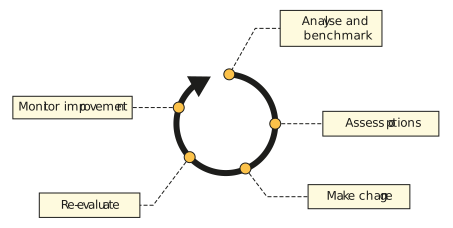
Figure: Continuous improvement cycle
Specific examples of methods to reduce energy consumption include:
-
Installing high-efficiency motors
-
Installing variable speed drives to optimise pump outputs and reduce starting loads
-
Good design of process pipework and pumps to minimise pressures and excess flow rates
-
Effective insulation of pipework systems, vessels and other exposed surfaces
-
Improving wort kettle vapour heat recovery and condensate recovery
-
Maximising refrigerant temperatures
-
Automatic shutdown/restart for computer systems
-
Installing movement sensors to control lighting
-
Improving building insulation
As well as running energy reduction projects, to reduce total carbon emissions it is important to investigate opportunities to use low and zero carbon energy sources and possibly increase energy security. Feasibility studies into these areas can be conducted to find the right opportunities for your brewery’s situation and may include:
-
Switching to fuels with lower carbon sources;
-
For example, switching from coal or oil to natural gas which has a much lower carbon footprint.
-
-
On-site renewable energy generation, including;
-
Photovoltaic cells for electrical generation.
-
Solar panels for thermal energy.
-
Biogas capture from anaerobic digester (waste water treatment plant) for heat or electricity generation on-site.
-
Burning of biomass to produce heat and power (steam and/or electricity).
-
For example, in some countries it is common for waste streams from other industries such as rice husk to be used in energy generation.
-
-
-
Purchasing electricity from renewable sources;
-
For example, purchasing green energy tariffs or power purchasing agreements with renewable energy projects away from the brewery site.
-
Here are a few examples of breweries that have significantly reduced their carbon footprint and in some cases achieving zero carbon:
https://sierranevada.com/about/sustainability/
https://www.edie.net/news/10/Carlsberg-unveils-first-carbon-neutral-brewery/