
Lesson 2 - Environmental Sustainability
In this lesson we will discuss key ways to understand and improve the sustainability of brewery operations. This will include understanding the global context for sustainability, the key environmental sustainability impacts of producing beer and opportunities for improving the sustainability of beer and brewing operations.
Point of Reflection – Reconvene
Welcome back! So, what were your thoughts?
The figure below depicts the carbon footprint of a typical beer brewed in Europe versus North America (NA). We can see that packaging material use can have a large impact on the overall carbon footprint.
The product in blue is a beer made in Europe in returnable glass packaging; it has an overall carbon footprint of 510.93 g CO2e / litre. The product in red is a beer made in North America in an aluminium can that has an overall carbon footprint of 903.13 g CO2e / litre. The packaging materials drive the main differences in the two footprints: the aluminium can creates 4.5 times the carbon emissions of the returnable glass bottle.
Sometimes this can be surprising to brewers: the returnable glass bottle must be returned and cleaned, consuming energy and other resources in the brewery before it can be refilled with beer. However, aluminium is very energy intensive to produce. A returnable glass bottle that can be used many times is more efficient in comparison.
Do the footprint and distribution surprise you or is it what you expected?
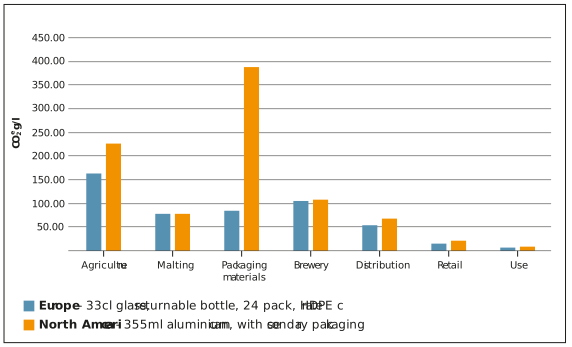
Figure: The carbon footprint of two different beers
There are many mitigation opportunities for decreasing carbon footprint across a beer’s life cycle including:
-
Conservation and regenerative agriculture techniques, such as low and zero till systems that build soil carbon.
-
Reducing malting and brewery energy use and transitioning to zero carbon energy (such as renewable energy like solar and wind power).
-
Increasing the recycled content of packaging materials and ensuring they are recycled.
-
Use of natural refrigerants such as propane and ammonia, as replacements to HFCs.
-
More efficient energy use in transport and zero carbon energy sources, such as biofuels or renewable energy in electric vehicles.
Project Draw Down is a great resource to understand the climate solutions available.
https://www.drawdown.org/solutions-summary-by-rank. Note, this is for illustrative purposes only and is not a recommendation or endorsement of the supplier's product.
Later in this lesson we will focus on how we can reduce the carbon emissions from our brewery operations.
The impact of climate change
Taking action to transition to a low or zero carbon economy is vital. As brewers are reliant on the environment for our raw materials, it is also important to consider how we adapt where a changing climate is becoming a reality. Exactly how the changing climate will affect our operations will be individual to brewery and supply chain circumstance and context.
Impacts could include:
-
Reduced crop yields
-
Increased water scarcity reducing water availability for brewing
-
Increased risk of flooding
-
Increased climate-related legislation and taxation
There are opportunities for us to become more resilient to a changing climate. In terms of adaptation, some of the main impacts that will affect us as brewers are likely to be related to water. We will look more at water as a topic later in the lesson.