
Lesson 2 - Environmental Sustainability
In this lesson we will discuss key ways to understand and improve the sustainability of brewery operations. This will include understanding the global context for sustainability, the key environmental sustainability impacts of producing beer and opportunities for improving the sustainability of beer and brewing operations.
Sustainability Context and Key Concepts
If we consider the life of a beer in its most fundamental form, it can be described as a series of flows – inputs and outputs to and from the environment.
Growing barley and hops rely on fertile soil, water, nutrients (whether organic or inorganic), pollinators, and the right conditions to grow. Depending on the farming methods employed, this process may discharge pollution into the air and water. Malting and brewing rely on large quantities of water and energy and their processes create solid waste, wastewater and greenhouse gases (GHGs) such as carbon dioxide. The packaging for beer consumes resources such as cardboard made from trees, metal, plastic, and glass. It can result in wastes that pollute the environment. Our supply chains are enabled by transport that consumes fossil fuels and emits GHGs in moving all these materials around. Finally, cooling our beers to the perfect temperature to drink also consumes electricity and can emit GHGs in its production.
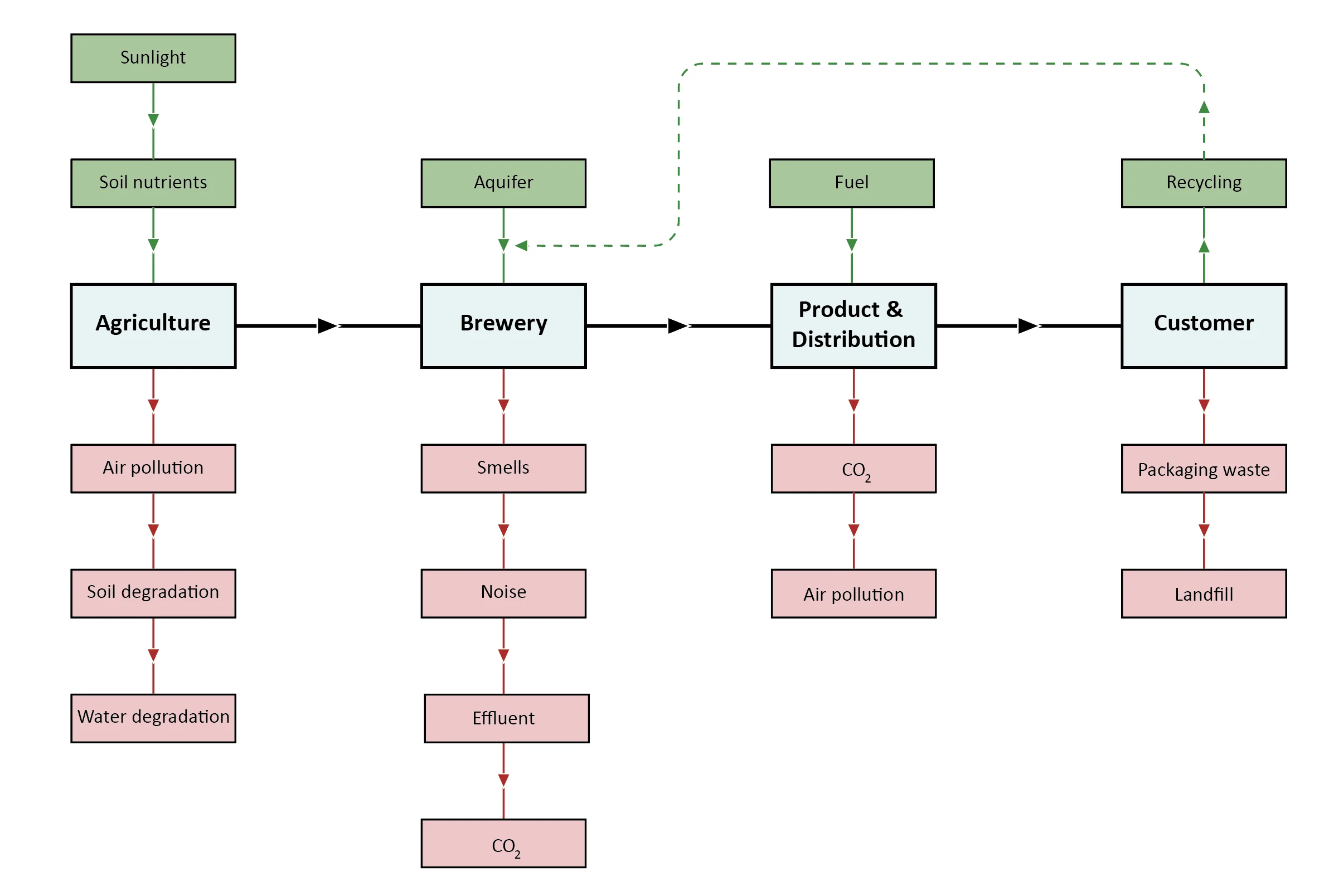
Figure: How beer and brewing rely on, and are part of the environment
As we can see from the figure above, brewers are deeply reliant on the environment and ecosystems we are part of. Unfortunately, if we are not responsible with the resources we rely on, we can negatively affect our environment. We must, therefore, run our operations in increasingly more sustainable and accountable ways.
While this may, to some, just feel like a noble aim, our communities and customers are increasingly demanding we do more to increase the sustainability of our operations and products. Not only is this important for anyone with a stake in the future but doing the right thing for the environment will often help to reduce production costs or give a valuable marketing edge to our products.