
Lesson 6 - Sensory Analysis
This lesson deals with the sensory analysis of beer. It details how to set up the elements of a sensory panel, such as panel selection, training, and the design of the sensory facilities, and then covers how to run the panel and collect the results. It discusses the various types of sensory test and their benefits before going on to cover the use of statistics to convert sensory data into information about the sensory quality of beer. Finally, it looks at the presentation of results from sensory tests and lists key flavour compounds in beer.
Point of Reflection - Reconvene
Welcome back. So, what were your thoughts?
The time required relates to the level of skill required. With difference tests, panellists just need to be able to use their sensory capabilities to answer simple questions. With descriptive tests, panellists need to learn the language of sensory analysis and to understand scales of intensity for many different aromas and tastes. They also have to learn how to discuss samples constructively with other panel members without being overbearing or submissive.
The Beer Flavour Wheel derived from the Flavour Terminology System, which was developed collaboratively by the EBC, ASBC, and Master Brewers Association of America in the 1970s. The system defines the technical language of beer. The language of the flavour wheel is:
-
Simple
-
Understandable
-
Objective (i.e. confers no negative connotations)
-
Related to source (process and ingredients)
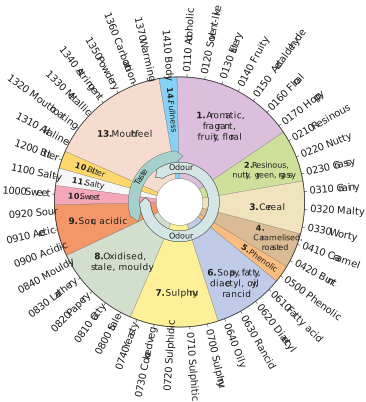
Figure: Beer Flavour Wheel
The Beer Flavour Wheel is composed of three levels of descriptors:
-
Class terms
-
First-tier terms
-
Second-tier terms
The class terms identify the grouping of the flavours by the kind of flavours that they contain, sulphury for example.
The first-tier contains types of flavour found in that class, for example, cooked veg.
The second-tier terms name and define each separately identifiable flavour note in beer; in our example this could be DMS (second-tier terms are not shown on the above wheel). Second-tier terms have flavour standards where possible.
In 2016 a new attempt to improve upon the flavour wheel was launched as a commercial product available to purchase and is shown below. Unlike the wheel, the compounds responsible for each of the flavour descriptors are not identified.
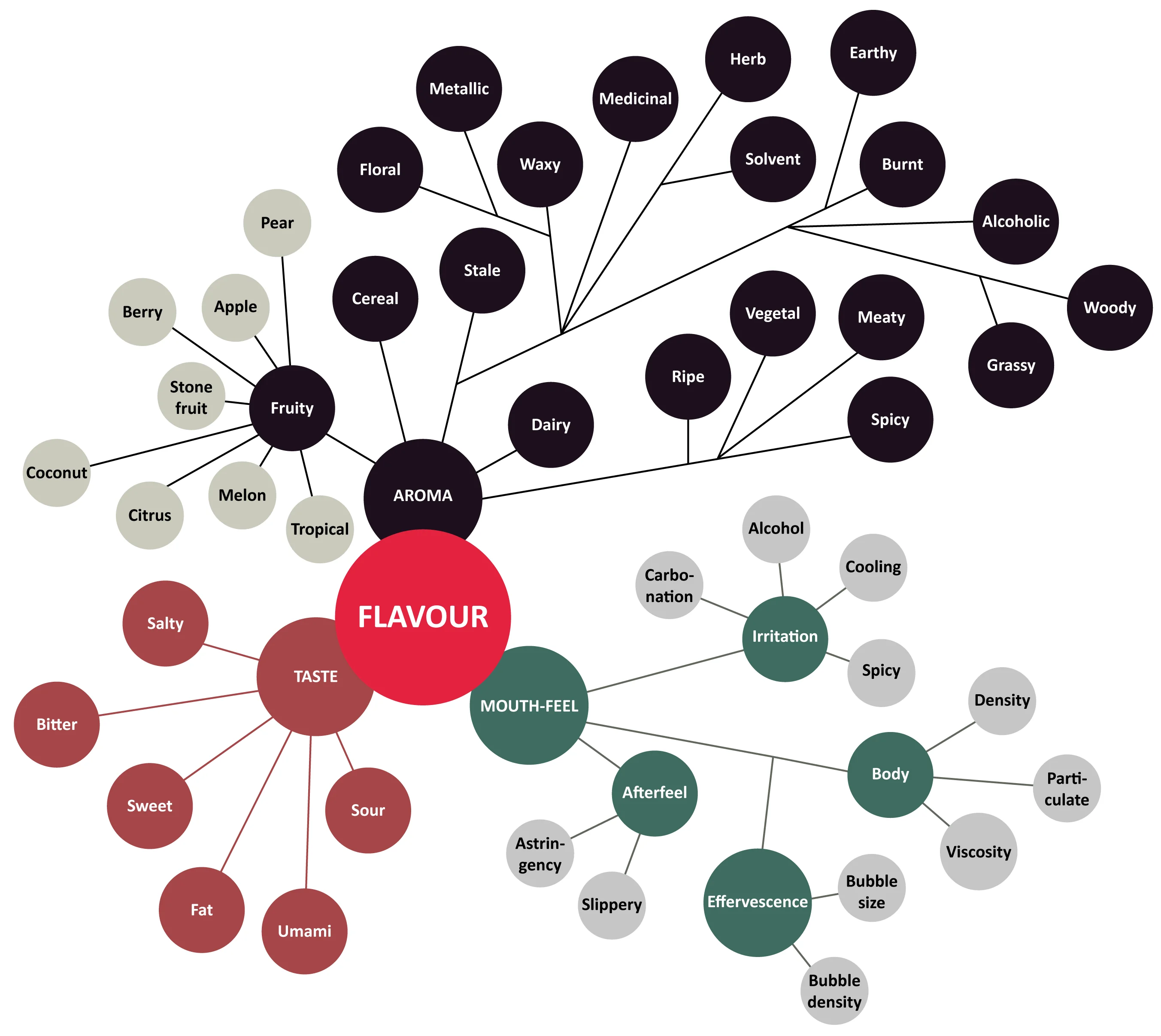
Figure: Beer flavour map
In training, panels start with familiarisation of the flavour standards in concentrated or aqueous form before moving on to detecting the flavour in beer. Triangle tests are used to embed and test recognition, and then ranking tests (covered later) are used to train assessors in rating flavour intensity. Reference samples should be used to anchor at least two points in the scale. For example, with a salty flavour 0.6 g/l of sodium chloride (the flavour threshold) is used for a weak intensity while 2.4 g/l is used for a strong intensity. The figure below shows examples of intensity scales; panel members draw marks or rings on the lines, or use the numbers (on the bottom scale) to fill boxes on the profiling form.
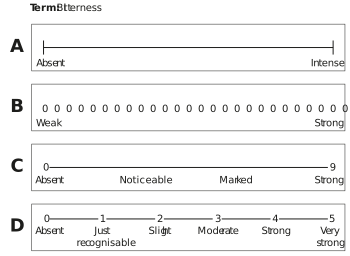
Figure: Intensity scales for descriptive analysis
The test procedure
In most breweries, the elements of flavour assessed are described by the second-tier of the beer terminology system. We can run preference tests before descriptive tests to identify terms which are particularly significant to the brand or important to the consumer and select these for assessment. For a simple test we would use 10-20 assessors, with more than 50 used for a full test.
Assessors taste the beer in sensory booths in isolation with no knowledge of the beer they are tasting. In a full descriptive test, a maximum of six samples should be tasted and the beers should be presented to the assessors at random. Some breweries break down the rating system on the tasting form into aroma, taste, and aftertaste so that these can be assessed and quantified individually. It is also usual to have a comments section for overall impressions of the beer. There should be no discussion of results until the tasting data have been collected. The mean intensity scores for each attribute across the panel can be calculated and the results presented on a histogram or spider web plot. Confidence widths can be calculated from data obtained by tasting the same beer over a period of months. If used in QC, results from each profiling can be plotted and overlaid on the standard graph to identify variations in a particular attribute.
The consensus procedure
The consensus procedure is used where there are insufficient panellists available as it allows the test to be performed by as few as eight assessors.
Once the data have been collected, the panel leader will provide details of the beers tested. The panel leader then leads an open discussion with a consensus reached for each point and outliers eliminated. The consensus procedure does not produce results which can be analysed statistically. Also, although the effect is minimised by effective management of personalities, panellists with louder voices and stronger opinions tend to influence the results to a greater degree than their quieter, more reserved counterparts. However, a benefit of the consensus procedure is that it provides ongoing training for panellists in the understanding of flavour terms.
As well as providing long and precise training, it is essential in descriptive testing to monitor panel and assessor performance. We can do this by assessing the same beer twice during a panel session or repeating the same beer on successive days without the knowledge of the assessors. Analysis of the data can provide an insight into the variation seen in the performance of assessors and flag them for more training or exclusion from the panel if the variation is marked.
The trademarked and commercially available descriptive tests have their own dedicated software packages. The results and reports are therefore developed automatically.
We have now taken the overall flavour of a beer and used a well managed panel to paint a ‘flavour picture’ of it. Next, we discover the remaining tests that we use to characterise our beer.