
Lesson 6 - Sensory Analysis
This lesson deals with the sensory analysis of beer. It details how to set up the elements of a sensory panel, such as panel selection, training, and the design of the sensory facilities, and then covers how to run the panel and collect the results. It discusses the various types of sensory test and their benefits before going on to cover the use of statistics to convert sensory data into information about the sensory quality of beer. Finally, it looks at the presentation of results from sensory tests and lists key flavour compounds in beer.
Tetrad test
The tetrad test is a new difference test and is catching up with the Triangle test in terms of popularity.
The key benefit of the tetrad test is that it is more statistically efficient than the Triangle test and Duo-Trio and a great deal more so than the paired comparison test (we will cover these later in the lesson). This means fewer assessors and hence samples are required. In the tetrad test four coded samples are presented to the assessors. Two samples are of one beer (A) and two samples are from another (B).
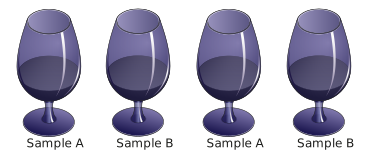
Figure: Glasses for the tetrad test
The samples are presented in one of six possible arrangements distributed evenly amongst the assessors, as shown below:
Assessor 1: AABB
Assessor 2: BBAA
Assessor 3: ABAB
Assessor 4: BABA
Assessor 5: ABBA
Assessor 6: BAAB
The assessors are then asked to pair the samples of the two different beers. When the differences between samples are known the test is called a specified tetrad test. When they are unknown it is known as unspecified. The tetrad test is not yet listed as a method by the European Brewery Convention (EBC).