
Lesson 6 - Sensory Analysis
This lesson deals with the sensory analysis of beer. It details how to set up the elements of a sensory panel, such as panel selection, training, and the design of the sensory facilities, and then covers how to run the panel and collect the results. It discusses the various types of sensory test and their benefits before going on to cover the use of statistics to convert sensory data into information about the sensory quality of beer. Finally, it looks at the presentation of results from sensory tests and lists key flavour compounds in beer.
How We Taste Things
Although we carry it out almost unconsciously every day, the biological process of tasting is very complex. We now consider the basics of what is involved.
The sensation of flavour is composed of two elements: taste (gustation) and smell (olfaction). The aroma of beer is detected by the olfactory epithelium, which is located at the back of the nose. Aroma molecules dissolve in the mucus which lines the olfactory epithelium and then bind to tiny hairs (cilia) on the olfactory receptor producing an electrical current. Sensory neurons then pass this electrical signal to the olfactory nerve which transmits it to the brain for processing.
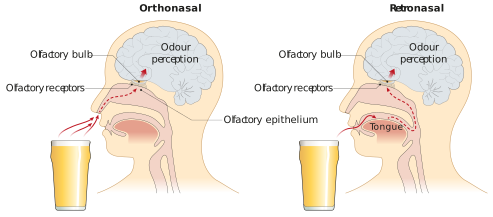
Figure: Olfaction
Aroma molecules can reach the olfactory epithelium via inhalation through the nose or from the back of the nasal cavity from the mouth (retronasal olfaction). To be detected as aroma, the molecule must be volatile enough to evaporate from the beer in the glass or in the mouth. We know a lot more about the compounds responsible for beer aroma than we do about those responsible for taste. The olfactory system can influence taste to an extent, for example there are certain sweet-smelling compounds which can cause a sweet sensation in the mouth.
The taste of beer is detected on the tongue, palate, and pharynx (back of the mouth and top of the throat). Most of the cells which detect taste are clustered together to form taste buds.
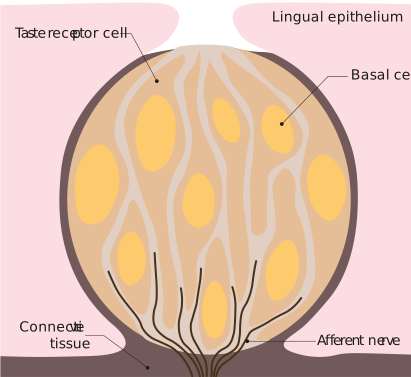
Figure: Taste bud
On the tongue these taste buds are found on folds and protrusions called papillae. The taste buds detect particular chemicals in the beer and, in response, send electrical signals to the brain for processing. It was once thought that taste buds on particular areas of the tongue were responsible for detecting particular elements of taste. We now know all tastes are detected by cells all over the tongue and mouth, with certain areas more specific and sensitive than others.
There are five basic tastes:
-
Bitter
-
Sweet
-
Sour
-
Salt
-
Umami
Another two tastes, kokumi which is richness in food and oleogustus which is the taste of fatty acids, have been suggested and are gaining acceptance. As well as these basic tastes, we can sense the temperature, texture, pain (CO2), astringency, heat (spiciness), and coolness (menthol) of food and drink we consume through the trigeminal nerve. We can also detect numbness, metal, and calcium.
We can see that flavour, which is made up of hundreds of compounds in beer, is sensed through a complex system of cells, tissues, and electrical pathways. With so many different elements to the detection of flavour, there are many sources of error and variation. The brain also has a difficult job in processing the array of information it receives and converting it into a sensible idea of flavour. It is small wonder, therefore, that there is significant variation between tasters and that every taster is, to some extent, less than perfect.
Next, we meet these tasters and find out what we do to minimise their weaknesses and how to select the best tasters for our sensory tests.