
Maths for Diploma Studies
This lesson is designed to provide the background knowledge in maths required to study CIBD Diplomas successfully. It will describe the basics of maths before detailing the more complex concepts encountered in CIBD lessons. Techniques for working with numbers, equations, and units will also be described.
Point of Reflection – Reconvene
Welcome back! So, what were your thoughts?

You can use the slider on the bottom of the animation to change from exponent to logarithm.
Here Loga (y) = x
-
a is the base, and x is the logarithm
-
a is multiplied together x times to give y
Sometimes base 10 logarithms are just written as log. If any other bases are used, their number is shown in subscript next to the log. There is one exception to this rule. Natural log is also called base e and written as ln. The natural base (e) is approximately 2.718, and the e button on your calculator will make this number appear on your display when you press it. The important aspect of a base is that, like exponents, they are fixed numbers. The result of the equation that changes enables us to work out unknown exponents or logarithms.
We can also have negative logarithms. These are the number of times 1 needs to be divided by the base to produce the number or the negative exponent used to produce the result.


You can do log base 10 and natural log calculations on your calculator, typing in the result and then pressing the log or ln button to give you the exponent.
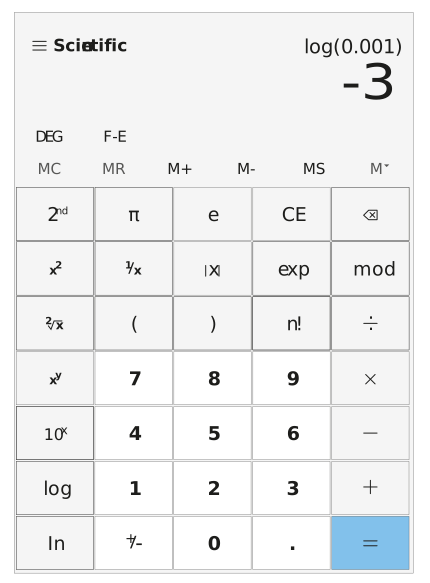
Figure: log10(0.001)
With log base 10, you can use the 10x button to get back to the original number. So if you raise the logarithm by 10 to the power of the logarithm, you get back to the number of interest. This is the inverse operation and becomes important later when we rearrange equations. Likewise, the inverse operation of taking a natural log is raising e by the power of the logarithm.
A use of logarithms we frequently encounter in beverage production is the pH scale. This is the negative of the base 10 logarithm of the molar concentration of H+ ions. Because it is the negative of a base 10 logarithmic scale, an increase of each pH point corresponds to a ten-fold decrease in the concentration of H+ ions. So a solution at pH7 has a 10 times lower concentration of H+ ions than a solution at pH6 and a 100 times lower concentration of H+ ions than a solution at pH5.
To help reinforce what we have just learned, on the next page there are some practice questions. Answers and explanations can be revealed by clicking on show answer.