
Maths for Diploma Studies
This lesson is designed to provide the background knowledge in maths required to study CIBD Diplomas successfully. It will describe the basics of maths before detailing the more complex concepts encountered in CIBD lessons. Techniques for working with numbers, equations, and units will also be described.
Working with Fractions
We now understand what fractions are and how they relate to cakes and overindulgence. In this section, we will discover how to add, subtract, multiply, and divide them.
Adding fractions
To add or subtract a fraction, you need to have a common denominator. For example, you can’t directly add  to get
 because the numerators are being divided by the different denominators, so they are not proportionate to each other. To get to a common denominator, we multiply the top and bottom of the fraction by the denominator of the other fraction like so (note that we only keep one common denominator), we don’t add the 63's:


Move the white slider at the bottom of this animation to see how to find the common denominator.
We can see that it should be possible to simplify this fraction. Both numerator and denominator divide by 3 so we can simply do:

And:

So we get:

We can’t simplify this any further because 13 is a prime number, so it is only divisible by itself and one. We can see that this fraction is significantly different to !
Subtracting fractions
We should not be surprised that for subtraction (the opposite of addition), we also need to have common denominators. We can use the same process:


We also need to simplify. Again we would use 3

And:
So we get:

Multiplying fractions
Multiplying fractions is pretty much the easiest thing you can do with them. You simply multiply one numerator by the other to get the new numerator and one denominator by the other denominator the get the new denominator. Here’s an example:

We should know by now that we should simplify our fraction. In this case is this is easy because 24 is half of 48, so if we divide the numerator and denominator by 24, we get  .
Dividing fractions
This is where we could expect things to get messy. If we write out the sum, it looks like a confusing pile of numbers:
 = ?
Fortunately, it’s no harder than multiplication because all you have to do is turn the denominator fraction upside down and then multiply the numerator fraction by it, as we did above. Just like this:

As always, we need to simplify. The largest number that both numerator and denominator can be divided by to reach a whole number is 2, so we end up with  .
You might ask yourself, why are we covering old fashioned stuff like fractions? The reason is that fractions appear in equations and when we manipulate (rearrange) equations and units of measurement, understanding the techniques for handling fractions is essential.
Fractions of whole numbers, decimals, and percentages
To work out what a fraction of a number is, you need to divide it by the denominator and then multiply the product by the numerator.
For example,  of 93 is given by:


To convert a fraction into a decimal, we divide the numerator by the denominator. In this instance:

If we multiply the number, we want to know the fraction of by our decimal we get the same number as we found above:

Decimals can be helpful and save us from needing to go through the mechanics of subtraction and addition of fractions. We can simply convert our fractions into decimals and use those to calculate the value. We can also use them to check calculations using fractions. Take our example from earlier:


We can check we have used the correct process by converting to decimals:


Converting fractions into decimals is also helpful if we have fractions of whole numbers described in a sum or equation. Let’s look at an example:

If we convert the fractions into decimals, it looks a bit less daunting:


So we have:


A decimal is the proportion of the numerator described by the fraction as written. So in the example below:

So if we multiply 0.125 by 8, we get back to 1:

To work out the proportion of 100 described by a fraction, we just need to multiply the decimal by 100. By doing this, we get the per cent:

To work out a percentage of a number, we divide the percentage we want to know by 100 to change it to a decimal and then multiply the number we want to know the percentage of by the resulting decimal.
To work out 42% of 134 we do this:

It’s very easy to work out the decimal of a percentage; you just move the decimal point two places to the left. So our percentage above becomes the decimal:

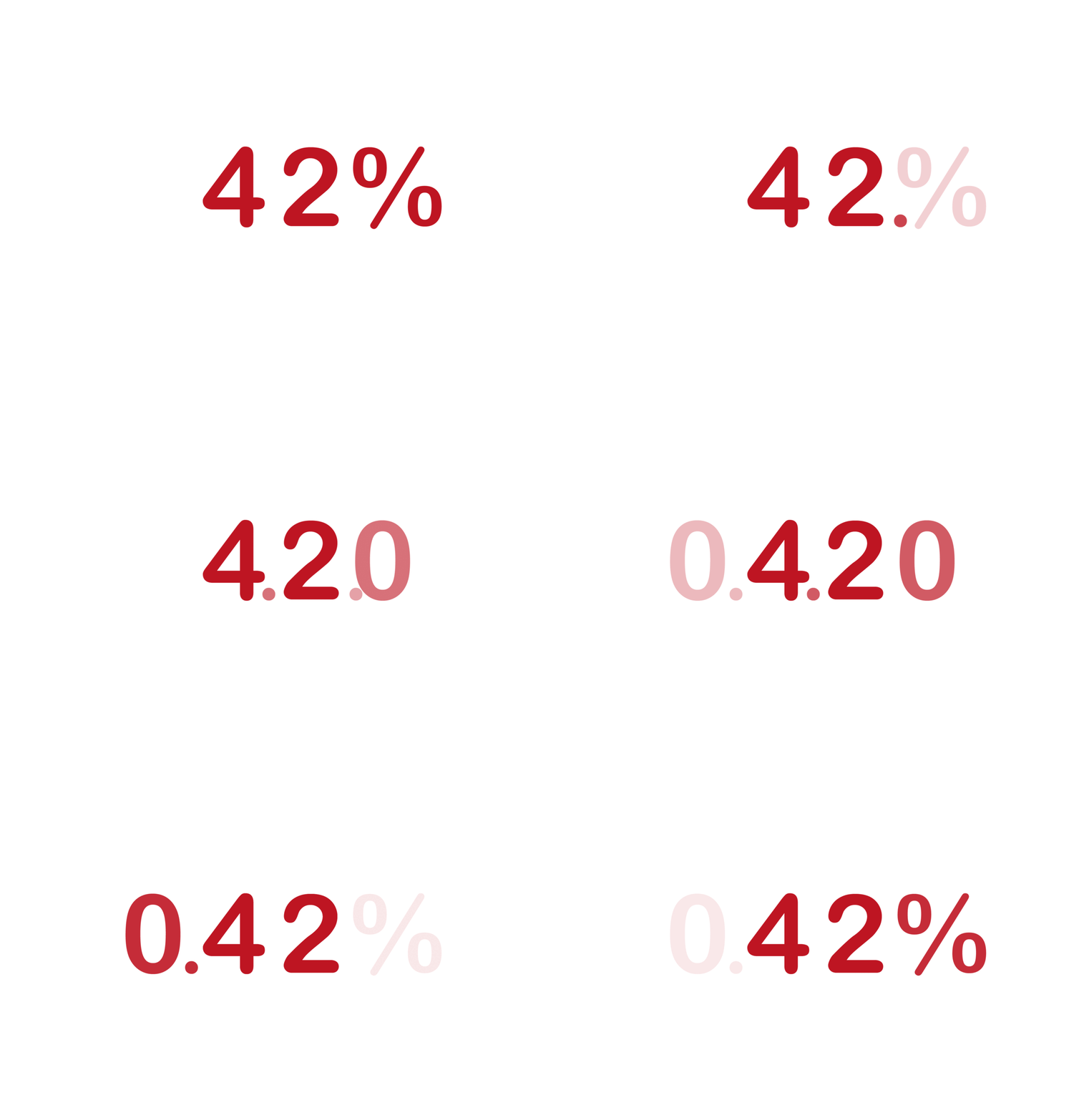
Knowing this makes percentage calculations easier because to calculate the percentage of something, we don’t need to divide by 100. Using the example above:

We can put this into practice by working out one number as a percentage of another. Let’s say 54 as a percentage of 222. To do this, we divide the number that will be a percentage of the other number by the other number, so:

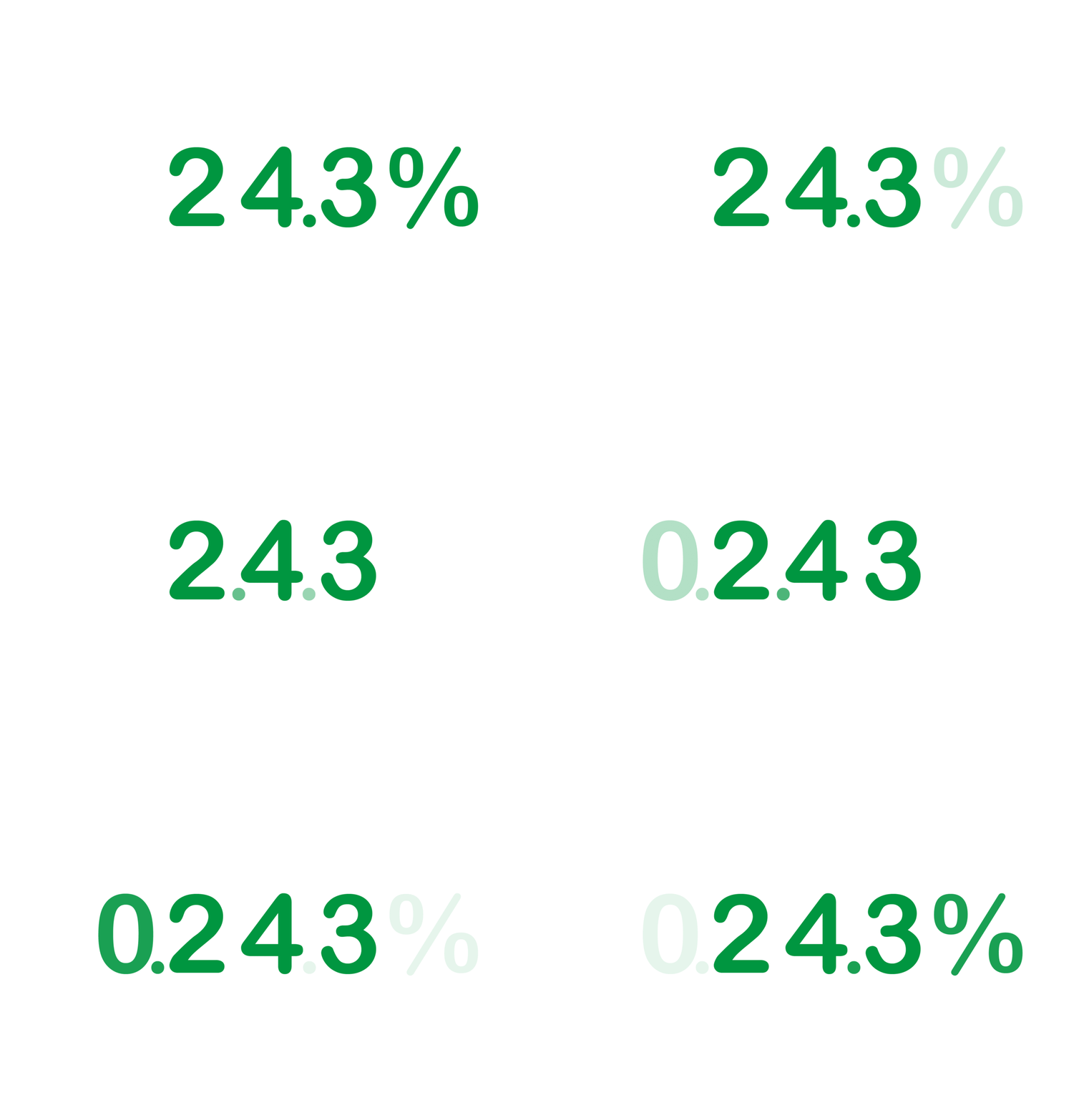
Then to get to the percentage, we can just move the decimal point two places to the right to give 24.3%.
A percentage doesn’t have to be less than 100. Take the opposite of the calculation above, for example. What percentage of 54 is 222, or to put it another way, what is 222 as a percentage of 54?

Moving the decimal point by two gives us a whopping 411%.
To work out the overall percentage from a set of percentages, you multiply the decimals and times by 100 or move the decimal place as above. The same applies to finding the percentage of a percentage.
For example, the overall yield from an operation/system made up of processes with yields of 99%, 98%, 94%, and 96% is:

Fractions and percentages are the basis of all yield calculations, so they are probably the maths you will use most in your day to day lives in production.
What is left over when a percentage yield is subtracted from 100 is the percentage loss. Have a go at this example:
If we use 220 boxes to hand package bottles and produce 197 packs for sale, what would our percentage yield be?
Give yourself 5-10 minutes to think about this, and then click ‘Next’ to continue with this lesson